Mentoring and peer support programme
Description
The Interpret Europe (IE) mentoring and peer-support programme is a three-year initiative (2026–2028) for heritage interpreters, in collaboration with Melting Pro, an Italian VET provider and specialist in cultural participation. It combines online training with structured mentoring relationships to support both early-career and more experienced freelance interpreters and trainers in developing their professional practice.
The programme is designed to support both IE members and non-members in strengthening their careers in the heritage interpretation sector, from freelance work to broader business development. It will help interpreters and trainers develop their practice, address gaps in knowledge and skills, and create opportunities for networking and collaboration. By nurturing the professional growth of heritage interpreters and equipping them with practical tools, the programme aims to foster a more sustainable and better recognised interpretive sector.
The programme places particular emphasis on entrepreneurial skills and transversal competencies that underpin the profession of heritage interpretation. Support is therefore closely aligned with the realities and needs of interpretive practice.
It should be noted that the mentoring and peer-support programme will not provide training in interpretation as IE has a separate vocational training programme for this precise task. The scheme instead complements the training programme to provide an overall package for professionals and to develop their businesses, particularly as freelance professionals.
The programme began with an online survey in late 2025 to map needs and gaps in business skills, market understanding and professional development. Based on these results, participants will be invited to join yearly cycles that include:
- One online workshop per year based on the results of the survey with sector experts on topics such as business development, client–provider relationships, self-marketing, fundraising and the use of digital/AI tools.
- One-to-one mentoring and peer-support relationships
After the matching phase, mentors and mentees will begin a one-to-one mentoring journey, with a minimum of four online sessions over the following months, organised directly by each pair. The coordination team provides light check-ins, clear guidelines, and practical tools to support the process. Alongside one-to-one mentoring, participants may also work in pairs or small groups through peer-mentoring exchanges, using a supportive setting to apply what they learn, clarify professional goals, and test new ideas. All mentoring relationships follow a structured cycle: agreeing shared goals, meeting regularly, and closing with a joint reflection and evaluation.
Who is the programme for?
The aim of the programme is to strengthen careers in the heritage interpretation sector by supporting both Interpret Europe members and a limited number of non-members. It helps interpreters and trainers address gaps in knowledge and skills, grow their practice, and build connections.
The programme will involve approximately 40 participants each year
Applications are welcome from:
- Freelance consultants and/or trainers
- Professionals who have recently started working in heritage interpretation
- Those approaching the field for the first time
- Senior professionals with and without mentoring experience who would like to support early-career interpreters
The programme is designed for heritage interpretation freelancers and trainers at different career stages:
- early-career interpreters who are starting out or consolidating their practice
- experienced trainers and consultants who want to expand or reposition their work
- senior professionals who want to act as mentors and support earlier-career colleagues
You can apply either as a mentor if you have experience to share, would like to grow through reflection, and want to support peers who are at an earlier stage of their journey – or as a mentee if you are looking to develop specific skills, clarify professional goals, grow your practice, or enter (or re-enter) the job market in heritage interpretation.
If you are interested in taking part, please send an email to mentoring@interpret-europe.net briefly stating your professional situation, your ambitions for a career in heritage interpretation, and what you would like to gain from mentoring.
Please consult our FAQ list and the programme overview below. Melting Pro will then follow up with a more detailed email explaining how the programme works and helping you decide which role best fits your profile and expectations.
How much does it cost to take part?
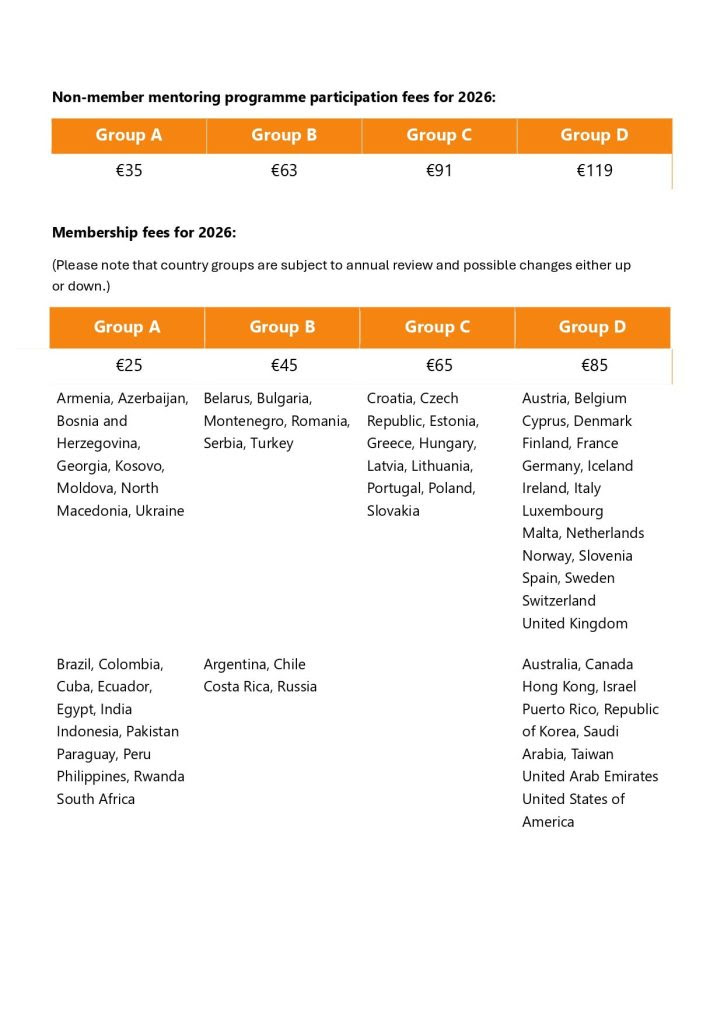
Participation is free for IE members, with a small charge for non-members. Non-IE member heritage professionals can access the mentoring programme by either joining IE from 2026 at individual membership fee level, or by remaining as non-members and instead paying an annual participation fee indexed to your country of residence as applies to IE membership fees (see below).
Programme overview
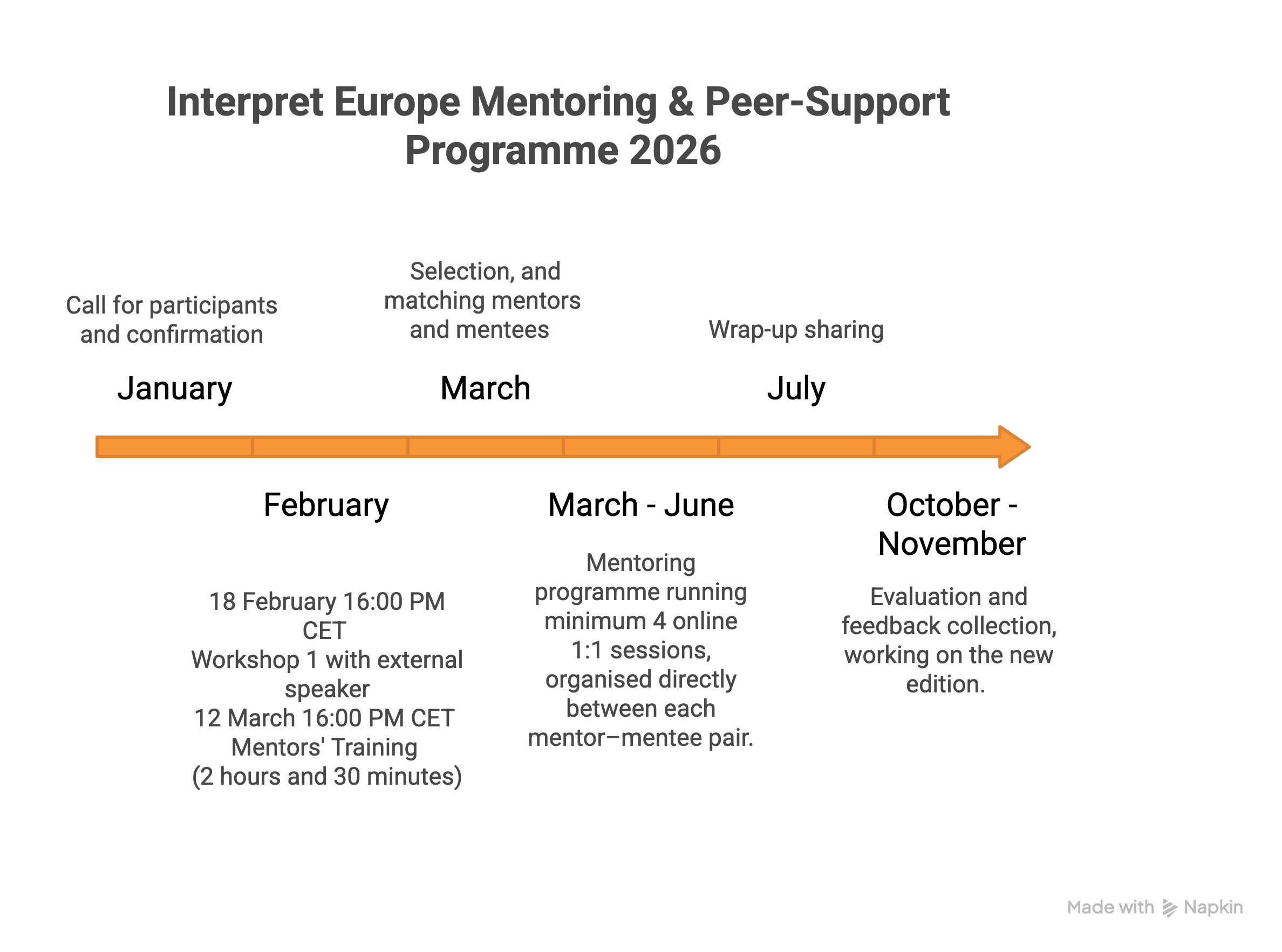
Here is an overview timeline of the Mentoring & Peer-Support Programme 2026, highlighting the main phases across the year. The key fixed dates are Wednesday 18 February 2026 at 16:00 CET (Workshop with an external guest and programme presentation) and Wednesday 12 March 2026 at 16:00 CET (Mentors’ training). Details about the wrap-up moment to celebrate and share reflections will be announced in due course.
FAQ
What is mentoring?
Mentoring can be described as a process – both formal and informal – of passing on knowledge and values through a structured, trust-based relationship between people. Typically, mentors provide guidance and support to help others develop their potential, strengthen knowledge and skills, and become more aware of their aspirations and strengths.
Mentoring creates a special space for personal and professional development, offering supportive guidance while ensuring the mentee remains in charge of the direction and decisions. Care and trust nurture a relationship that can make a real difference for those who choose to engage in an open and authentic exchange. Mentoring can support people at any age – whether they are starting out, changing direction, or building on long experience.
Mentoring is more than a set of skills; it is a movement of generous individuals who share their knowledge, experience, and time to support others through meaningful professional and personal growth. David Clutterbuck describes mentoring as “off-line help by one person to another in making significant transitions in knowledge, work, or thinking.”
Who is the programme for?
The programme is designed for heritage interpretation freelancers and trainers at different career stages:
- early-career interpreters who are starting out or consolidating their practice;
- experienced trainers and consultants who want to expand or reposition their work;
- senior professionals who want to act as mentors and support earlier-career colleagues.
It is primarily intended for Interpret Europe members, and also open to a limited number of non-member professionals each year.
You can apply either as a mentor if you have experience to share, would like to grow through reflection, and want to support peers who are at an earlier stage of their journey – or as a mentee if you are looking to develop specific skills, clarify professional goals, grow your practice, or enter (or re-enter) the job market in heritage interpretation. Melting Pro will then follow up with a more detailed email explaining how the programme works and helping you decide which role best fits your profile and expectations.
What are the main benefits for mentees?
Mentees can expect:
- a supportive, confidential space to clarify goals and next steps;
- practical help to grow a freelance or training practice (including confidence, positioning, and client work);
- feedback on ideas and projects from someone with relevant experience;
- international connections and peer exchange within the Interpret Europe community.
What are the main benefits for mentors?
Mentors benefit through:
- access to the programme’s expert workshop(s) and updated tools and methods;
- structured reflection on their own practice and professional positioning;
- expanded professional network in a European community of peers;
- the satisfaction of supporting colleagues and strengthening the field.
Is the online needs analysis survey for mentees only?
The survey mainly focuses on mapping the needs of early-career professionals and potential mentees, because this information is essential to design the workshops and support offer.
However, senior interpreters who are interested in becoming mentors are very welcome to fill it in too – their answers help us understand the wider training and support needs in the community. A dedicated mentor call and information pack will follow, with more specific questions about mentors’ profiles, motivations and availability.
Becoming a mentor
Senior interpreters are invited to join the programme as mentors, offering their professional experience to support early-career colleagues. As mentors, they:
- provide a trust-based space for reflection, rather than “giving the right answers”
- help mentees clarify their professional identity, business ideas and development goals;
– share real-life experience about working with clients, designing and delivering interpretation projects, and building a sustainable freelance practice - use structured conversations and simple tools (e.g. goal-setting, business model canvas, skills mapping) to help mentees turn ideas into concrete next steps.
Mentors receive an introductory training on mentoring, ongoing support from the programme tutor and access to the same expert workshops as mentees. This means they also benefit from updating their own skills, expanding their network and reflecting on their practice in a European community of peers.
Senior interpreters interested in being mentors can indicate their interest in the online needs analysis survey (where relevant), and/or contact the mentoring@interpret-europe.net to be added to a list for the mentor call that will be issued once the programme design is finalised.
What is expected from mentors in practice?
Mentors are expected to:
- attend the online mentor training session at the start of the cycle;
- agree goals, meeting rhythm, and ground rules (confidentiality, boundaries) with their mentee;
- hold a minimum of 4 online meetings (about 1 hour each);
- keep brief notes (as appropriate) to support programme learning and evaluation;
- join occasional check-ins and, where possible, group reflection moments with other mentors.
The emphasis is on mutual learning: mentors are not expected to have all the answers, but to help mentees think through options and make their own decisions.
Is the mentor role paid?
Mentoring is conceived as a professional volunteering or pro-bono contribution. Mentors receive training, tools, access to workshops, and visibility and networking opportunities within the Interpret Europe community.
Who can become a mentor?
We are looking for senior or mid-career interpreters who:
- have solid experience in heritage interpretation (as freelancers, trainers, consultants or project leaders);
- are willing to share their professional journey, including challenges and lessons learned
- enjoy listening, asking questions and supporting others’ growth
- can commit to a series of regular online meetings over an agreed period.
Formal coaching qualifications are not required. Mentors will receive an introductory training on mentoring and a simple toolkit to guide their meetings.
Matching and formats
How are mentors and mentees matched?
Each year we will define a “theme of the year” based on what participants say they most need and value in the survey, and we will use those same focus areas to guide the whole cycle – including mentoring matches.
Matching is based on:
- professional profile and experience
- areas of interest and competency gaps
- language and time-zone compatibility
- any specific preferences expressed by participants.
The programme team reviews the profile and follows up with a short interview to propose pairs or small groups. If a match does not work, there will be a possibility to adjust after an initial trial phase.
The exact mix will be fine-tuned based on the needs that emerge from the online survey.
How much time does the programme require?
For one annual cycle (rough indication):
- Workshops: 1 online workshop per year, approx. 2 hours
- Mentoring: training of mentors (2 hours and 30 minutes), around minimum of 4 mentoring meetings (about 1 hour each), plus short preparation / follow-up time
- Optional: brief check-ins and evaluation activities.
All workshops will be held in English but the language used in mentor–mentee pairs can be agreed directly between them.
Participants can join one or more yearly cycles, depending on their availability and interest.
Is mentoring one-to-one or peer-to-peer?
The core format is one-to-one mentoring, with additional peer-to-peer moments between mentors and mentees and larger group exchange and networking during workshops) where useful. The mix can be fine-tuned based on needs emerging from the survey and ongoing evaluation.
What is Melting Pro’s role?
Melting Pro is a cultural cooperative founded in Rome in 2011. It works across culture, heritage and the arts with a strong focus on empowering people and communities. As a cultural enterprise, It responds to contemporary social challenges by putting listening, experimentation and creativity at the heart of what it does. Over the years, it has grown through national and European initiatives that have enabled it to test and refine culture-based social innovation methods.
Today, one of its core activities is to design and deliver training, mentoring and capacity-building programmes for heritage professionals, working through peer learning, co-design and human-centred facilitation, with experience in audience development and international collaboration.
Melting Pro’s role is to deliver the mentoring training and organise the full mentoring pathway. It coordinates the call and orientation of participants, supports the matching of mentors and mentees, and provides a clear structure for the cycle – shared guidelines, practical tools, and light check-ins – to help participants make the most of each exchange.
Melting Pro believes that mentoring is a powerful way to strengthen practice and confidence, and ultimately to empower communities. It also matters to the Melting Pro team personally: “We know what it means to need guidance, because we have benefitted from mentoring ourselves. That experience shapes the way we design the programme – grounded, supportive, and focused on real progress”.

Funded by the European Union. Views and opinions expressed are however those of the author(s) only and do not necessarily reflect those of the European Union or the European Education and Culture Executive Agency (EACEA). Neither the European Union nor EACEA can be held responsible for them.