Description
The Interpret Europe (IE) mentoring and peer-support programme is a three-year initiative (2026–2028) for heritage interpreters, in collaboration with Melting Pro, an Italian VET provider and specialist in cultural participation. It combines online training with structured mentoring relationships to support both early-career and more experienced freelance interpreters and trainers in developing their professional practice.
The programme is designed to support both IE members and non-members in strengthening their careers in the heritage interpretation sector, from freelance work to broader business development. It will help interpreters and trainers develop their practice, address gaps in knowledge and skills, and create opportunities for networking and collaboration. By nurturing the professional growth of heritage interpreters and equipping them with practical tools, the programme aims to foster a more sustainable and better recognised interpretive sector.
The programme places particular emphasis on entrepreneurial and transferrable skills that underpin the profession of heritage interpretation. Support is therefore closely aligned with the realities and needs of interpretive practice.
It should be noted that the mentoring and peer-support programme will not provide training in interpretation as IE has a separate vocational training programme for this precise task. The scheme instead complements the training programme to provide an overall package for professionals and to develop their businesses, particularly as freelance professionals.
Who is the programme for?
The programme is designed for heritage interpretation freelance consultants and trainers at different career stages who are IE members and non-members:
- early-career interpreters who are starting out or consolidating their practice;
- experienced trainers and consultants who want to expand or reposition their work;
- senior professionals who want to act as mentors and support earlier-career colleagues.
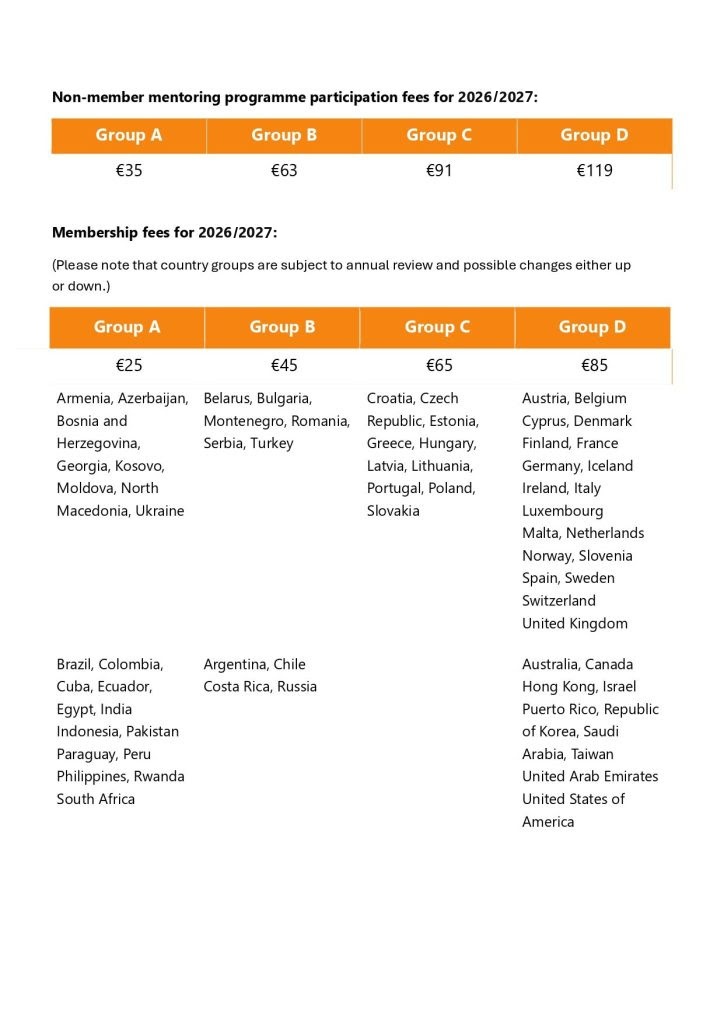
Non-IE member heritage professionals can access the mentoring programme by either joining IE from January 2027 at individual membership fee level, or by remaining as non-members and instead paying an annual participation fee indexed to your country of residence as applies to IE membership fees (see below).
The programme began with an online survey in late 2025 to map needs and gaps in business skills, market understanding and professional development. Each yearly cycle has a theme of the year, inspired by the needs analysis. The 2026 cycle focused on digital branding skills. The 2026–2027 cycle focuses on facilitation and co-creation, and in particular developing a freelance offer around facilitation and co-creation.
You can explore this theme with your mentor, or work on any other business development or entrepreneurial challenge that matters to you right now. Some of the topics you might explore in your mentoring relationship are:
- Developing your projects: turning an idea into a project, or making an existing one more sustainable
- Defining your skills: recognising what you can offer and communicating it with confidence
- Business positioning: presenting facilitation as part of your professional offer and finding the clients and contexts that suit you
- Managing client relationships: clarifying expectations, negotiating scope and fees, and building long-term collaborations
- Reflective practice and professional growth: learning from experience and continuing to develop your skills over time
- Expanding your network: building local and international contacts and opportunities to collaborate
This year’s programme cycle runs from November 2026 to July 2027:
- One online kick-off workshop on the theme of the year (about 2 hours), with external keynote speakers and a presentation of the programme on Tuesday 10 November 2026, 16:00–18:00 CET (Register here)
- Matching participants
- A live training and peer learning session on 3rd December 2026 online 16:00–18:00 CET
- One-to-one mentoring, with a minimum of six online meetings between matched mentors and mentees.
- Three collective peer learning sessions, open to all participants
- A wrap-up and sharing session to celebrate and reflect together
Deadline to join the programme is 20 November 2026
If you want to apply as a mentee please fill out the <<FORM>>
If you want to apply as a mentor please fill out the << FORM>>
We welcome applications from:
- Freelance consultants and/or trainers
- Professionals who have recently started working in heritage interpretation
- Those approaching the field for the first time
- Senior professionals with and without mentoring experience who would like to support early-career interpreters
After the matching phase, mentors and mentees begin a one-to-one mentoring journey, with a minimum of six online sessions of about one hour each between January and June 2027, organised directly by each pair. Overall, participation amounts to 15 to 20 hours over the whole cycle, roughly two hours a month.
Every pair receives a Mentoring Toolkit that guides each meeting. The coordination team provides tutoring and light check-ins (after the first meeting and halfway through the journey), clear guidelines and practical tools to support the process.
Mentoring does not stop at the one-to-one relationship. Alongside the meetings with your mentor or mentee, the collective peer learning sessions are a chance for all participants to meet, share their challenges and build connections across the whole cohort.
Please consult our FAQ list and the programme overview below.
Meet the 2026 cohort
What does it really mean to be part of the Interpret Europe Mentoring and Peer Support Programme? The best way to answer this question is to hear what the participants of our first edition said. Meet the 2026 cohort and read their stories here!
Some testimonials
Ruby Villareal (mentor)
“We are not competitors. We are like one thread together with another thread: when you weave them together, the net is stronger.”
Aurélia Bachoríková (mentee)
“The mentoring programme for me is like a real university of life, connected to something I am doing now. I realised that I should not wait for a perfect outcome, because nobody is perfect. Waiting for the perfect result is a waste of time. We have to learn by doing.”
Eftihia Xiruhaki (mentor)
“Mentoring is something I enjoy very much. What you have in your head starts to go away as you get older, and you want to pass it on. You want to spread it. For me, it is very fulfilling.”
Andreia Marujo (mentee)
“My mentor encouraged me to be more visible and to trust what I can offer, and that stayed with me.”
Indy Hujan (mentor)
“The programme reinforced for me how much I enjoy this work and what a privilege it is, and how much I would like to do more of this with more people.”
Jana Vodičková (mentee)
“One of the strongest potential benefits of the programme is its focus on freelancers. Many mentoring programmes are designed for people working within institutions or heritage organisations, while freelancers face a specific set of circumstances. It would be valuable for Interpret Europe to develop a framework that responds directly to freelance realities.”
FAQ
Mentoring can be described as a process – both formal and informal – of passing on knowledge and values through a structured, trust-based relationship between people. Typically, mentors provide guidance and support to help others develop their potential, strengthen knowledge and skills, and become more aware of their aspirations and strengths.
Mentoring creates a special space for personal and professional development, offering supportive guidance while ensuring the mentee remains in charge of the direction and decisions. Care and trust nurture a relationship that can make a real difference for those who choose to engage in an open and authentic exchange. Mentoring can support people at any age – whether they are starting out, changing direction, or building on long experience.
Mentoring is more than a set of skills; it is a movement of generous individuals who share their knowledge, experience, and time to support others through meaningful professional and personal growth. David Clutterbuck describes mentoring as “off-line help by one person to another in making significant transitions in knowledge, work, or thinking.”
The programme is designed for heritage interpretation freelancers and trainers at different career stages members and not members ( please see below conditions for not members):
- early-career interpreters who are starting out or consolidating their practice;
- experienced trainers and consultants who want to expand or reposition their work;
- senior professionals who want to act as mentors and support earlier-career colleagues.
Applications are welcome from:
- Freelance consultants and/or trainers
- Professionals who have recently started working in heritage interpretation
- Those approaching the field for the first time
- Senior professionals with and without mentoring experience who would like to support early-career interpreters
Non-IE member heritage professionals can access the mentoring programme by either joining IE from 2026 at individual membership fee level, or by remaining as non-members and instead paying an annual participation fee indexed to your country of residence as applies to IE membership fees (see FAQ How much does it cost to take part? below).
You can apply either as a mentor if you have experience to share, would like to grow through reflection, and want to support peers who are at an earlier stage of their journey – or as a mentee if you are looking to develop specific skills, clarify professional goals, grow your practice, or enter (or re-enter) the job market in heritage interpretation. Melting Pro will then follow up with a more detailed email explaining how the programme works and helping you decide which role best fits your profile and expectations.
Applications close on Friday 20 November 2026
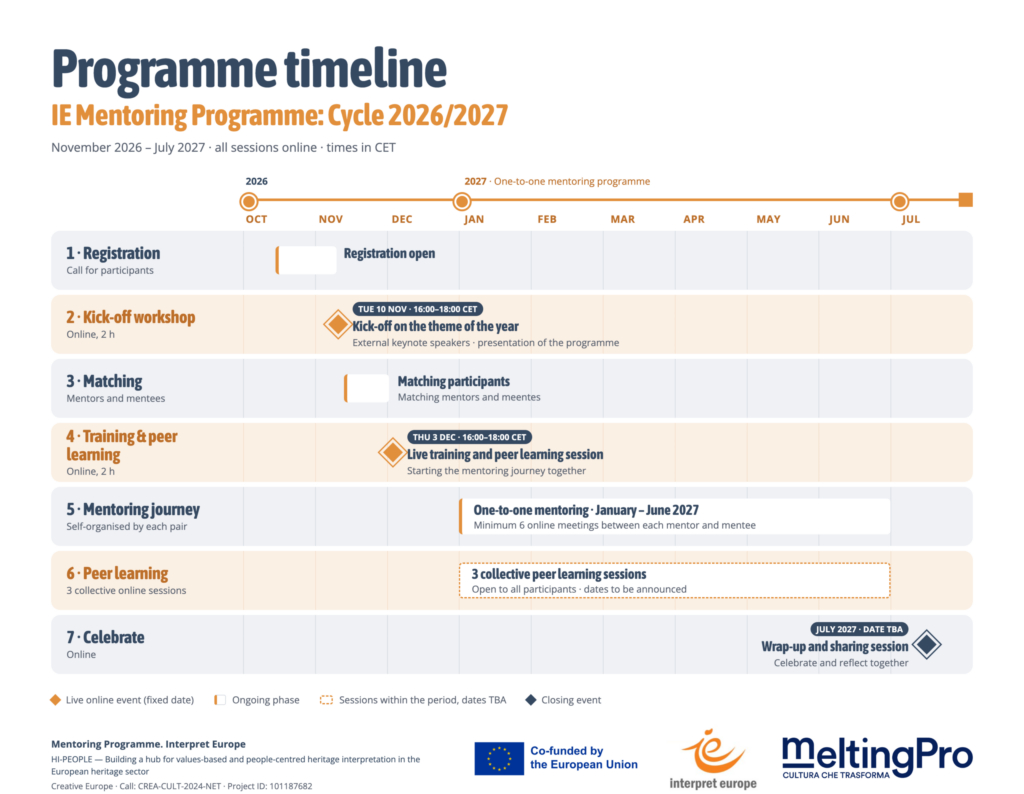
Here is an overview of the Mentoring & Peer-Support Programme 2026–2027, from October 2026 to July 2027.
- Launch workshop: the cycle opens with a call for mentors and mentees and a launch workshop on facilitation and co-creation, with guest speakers, on Tuesday 10 November 2026, 16:00–18:00 CET, online. Please register here.
- Mentor, mentee applications close: Friday 20 November 2026.
- Matching and training: matching is challenge-based and done remotely. It is followed by a live online training for mentors and mentees on Thursday 3 December 2026, 16:00–18:00 CET.
- Mentoring journey (January–June 2027): each pair holds six one-to-one meetings, and three collective networking events are open to all participants.
- 3 collective networking events
- Celebration (July 2027): the cycle closes with a wrap-up and sharing session. The exact date will be announced in due course.
Participation is free for IE members, with a small charge for non-members. Non-IE member heritage professionals can access the mentoring programme by either joining IE from 2027 at individual membership fee level, or by remaining as non-members and instead paying an annual participation fee indexed to your country of residence as applies to IE membership fees (see below).
Yes. Each year’s theme is chosen from a needs analysis carried out in November 2025. The 2026 cycle focused on digital branding skills. The 2026–2027 cycle focuses on facilitation and co-creation, and specifically developing a freelance offer around facilitation and co-creation. The theme shapes the kick-off workshop and the peer learning sessions.
With your mentor, you can work on the theme or on any other business development or entrepreneurial challenge linked to your practice as a heritage interpreter.
No. IE’s training courses already provide methods and techniques to facilitate and co-create effectively. Of course, mentor/mentee pairs may well exchange their experiences and lessons learned in participatory practices, but mentoring focuses more on what comes after training:
- how to become a facilitator people choose to hire;
- good judgement and decision-making;
- business positioning;
- managing client relationships;
- creating sustainable facilitation work;
- reflective practice and professional growth.
Mentees can expect:
- a supportive, confidential space to clarify goals and next steps;
- practical help to grow a freelance or training practice (including confidence, positioning, and client work);
- feedback on ideas and projects from someone with relevant experience;
- international connections and peer exchange within the Interpret Europe community;
- a Mentoring Toolkit that guides each meeting, from getting to know each other to the closing reflection.
Mentors benefit through:
- access to the programme’s expert workshop(s) and updated tools and methods;
- structured reflection on their own practice and professional positioning;
- expanded professional network in a European community of peers;
- the satisfaction of supporting colleagues and strengthening the field.
Recruitment for the 2026–2027 cycle opens in mid-October 2026 and closes in November 2026. There are two short application forms, one for mentors and one for mentees. Mentees are asked to describe their main professional challenges, which are the starting point for matching. Mentors are asked about their experience.
This information is used to create a short profile card that is shared with your mentoring partner. As the programme is funded by the European Union, materials produced during the cycle may be used to document and disseminate its results.
Applications close on Friday 20 November 2026 (see mentor, mentee application forms above)
Matching and formats
Each year we define a “theme of the year” based on the needs analysis, and we use it to guide the whole cycle. Matching, however, starts from mentees’ real challenges, whether or not they are linked to the theme.
This is how it works:
- mentees describe their main professional challenges in the application form;
- each mentor chooses two or three challenges they feel more confident about;
- language and time-zone compatibility, and any specific preferences expressed by participants, are also taken into account.
Ideally, pairs then meet at a live online training on the 3 December 2026: one hour of training together, including the ground rules that keep a mentoring relationship alive, followed by one hour for each pair to talk one-to-one and agree on frequency, language and way of working. Taking part in this session is highly recommended to join the cycle.
A quick check after the first meeting helps flag up any issues early. If a second meeting is missed without being rescheduled, the pairing ends and participants are reassigned.
Each mentoring relationship is different, but we suggest a simple structure: getting to know each other, agreeing shared goals, meeting regularly, and closing with a joint reflection and evaluation.
Every pair receives a Mentoring Toolkit that guides each meeting:
- Getting to know each other: people, professional paths and values, before any plan
- Each other’s work: needs and expectations; signing the Mentoring Agreement
- Goals and plan: one realistic goal and a calendar of meetings
- Working on the goal: actions, contacts and feedback on ideas
- Mid-way review: what is working and what to adjust
- Closing reflection: results, learning and next steps
The core format is one-to-one mentoring: each pair is made up of one mentor and one mentee. Alongside it, three collective peer learning sessions between January and May 2027 are open to all participants (no need to attend as a pair).
Becoming a mentor
Senior interpreters are invited to join the programme as mentors and share their professional experience with early-career colleagues. As a mentor, you will:
- offer a space built on trust where mentees can reflect, rather than handing them “the right answers”;
- help mentees clarify their professional identity, business ideas and development goals;
- share real-life experience of working with clients, designing and delivering interpretation projects, and building a sustainable freelance practice;
- use structured conversations and simple tools, such as goal-setting, the business model canvas and skills mapping, to help mentees turn ideas into concrete next steps.
Mentors receive an introductory training on mentoring, ongoing support from the programme tutor, and access to the same expert workshops as mentees. You also update your own skills, grow your network and reflect on your practice within a European community of peers.
We are looking for senior or mid-career interpreters who:
- have solid experience in heritage interpretation (as freelancers, trainers, consultants or project leaders);
- are willing to share their professional journey, including challenges and lessons learned
- enjoy listening, asking questions and supporting others’ growth
- can commit to at least six online meetings between January and June 2027.
Formal coaching qualifications are not required. Mentors will receive an introductory training on mentoring and a toolkit that guides each meeting.
How matching works
Matching is based on the mentees’ challenges. When they apply, mentees describe the main professional challenges they want to work on. Matching is done remotely, using your choices and the mentees’ needs.
Each year we define a “theme of the year” based on the needs analysis, and we use it to guide the whole cycle. Matching, however, starts from mentees’ real challenges, whether or not they are linked to the theme.
This is how it works:
- mentees describe their main professional challenges in the application form;
- each mentor chooses two or three challenges they feel more confident about;
- language and time-zone compatibility, and any specific preferences expressed by participants, are also taken into account.
Ideally, pairs then meet at a live online training on the 3 December 2026: one hour of training together, including the ground rules that keep a mentoring relationship alive, followed by one hour for each pair to talk one-to-one and agree on frequency, language and way of working. Taking part in this session is highly recommended to join the cycle.
A quick check after the first meeting helps flag up any issues early. If a second meeting is missed without being rescheduled, the pairing ends and participants are reassigned.
Expect to devote about 12–15 hours in total, spread over November 2026 to July 2027. During the mentoring phase works out at roughly 1–2 hours a month.
Required:
- 6 one-to-one online meetings with your mentee, of about 1 hour each, between January and June 2027, plus a little preparation for each, scheduled accordingly with your mentee.
- Training for mentors and mentees: Thursday 3 December 2026, 16:00–18:00 CET, online (2 h).
- Wrap-up and sharing session in July 2027 (2 h), plus a short feedback form.
Recommended:
- Launch workshop with speakers: Tuesday 10 November 2026, 16:00–18:00 CET, online (2 h).
- 3 collective networking events between January and June 2027, open to all participants. You do not need to attend as a pair.
Applications close on Friday 20 November 2026.
Senior interpreters interested in being mentors can apply when recruitment opens in mid-October 2026, or contact mentoring@interpret-europe.net at any time to be added to the list for the mentor call.
During the mentoring journey (January–June 2027)
- agree goals, meeting rhythm, language and ground rules (confidentiality, boundaries) with your mentee, and sign the Mentoring Agreement together;
- hold at least six online meetings of about one hour each, using the Mentoring Toolkit as a guide;
- keep brief notes, where useful, to support programme learning and evaluation;
- give quick feedback after your first meeting and join the mid-programme check-in.
Throughout the cycle
- join the collective peer learning sessions and the wrap-up session in July 2027 when you can.
You don’t need to have all the answers. Mentoring is about mutual learning: your role is to listen, share your experience and help your mentee think through options and make their own decisions.
Mentoring is conceived as a professional volunteering or pro-bono contribution. Mentors receive training, tools, access to workshops, and visibility and networking opportunities within the Interpret Europe community.
What is Melting Pro’s role?
Melting Pro is a cultural cooperative founded in Rome in 2011. It works across culture, heritage and the arts with a strong focus on empowering people and communities. As a cultural enterprise, It responds to contemporary social challenges by putting listening, experimentation and creativity at the heart of what it does. Over the years, it has grown through national and European initiatives that have enabled it to test and refine culture-based social innovation methods.Today, one of its core activities is to design and deliver training, mentoring and capacity-building programmes for heritage professionals, working through peer learning, co-design and human-centred facilitation, with experience in audience development and international collaboration.
Melting Pro’s role is to deliver the mentoring training and organise the full mentoring pathway. It coordinates the call and orientation of participants, supports the matching of mentors and mentees, and provides a clear structure for the cycle – shared guidelines, practical tools, and light check-ins – to help participants make the most of each exchange.
Melting Pro believes that mentoring is a powerful way to strengthen practice and confidence, and ultimately to empower communities. It also matters to the Melting Pro team personally: “We know what it means to need guidance, because we have benefitted from mentoring ourselves. That experience shapes the way we design the programme – grounded, supportive, and focused on real progress”.

Funded by the European Union. Views and opinions expressed are however those of the author(s) only and do not necessarily reflect those of the European Union or the European Education and Culture Executive Agency (EACEA). Neither the European Union nor EACEA can be held responsible for them.