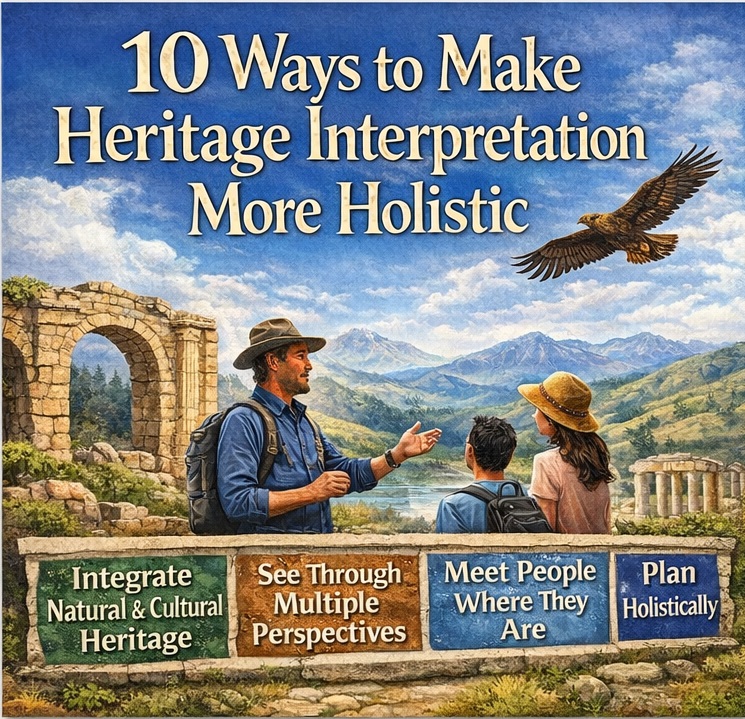
We consider ten ways to make heritage interpretation more holistic for greater impact.
Interpretation might play on a field two sizes too small. Of course, you may not be sure if your interpretation does or not, until you zoom beyond the small field. It is hard to imagine the feel of playing inside a major soccer stadium if you have only ever played on a local field.
To upscale, both the way interpreters think and do must take in more of the big picture by including previously hidden dimensions, perspectives, forces, and goals. Below, I share five ways of thinking and five ways of doing more holistically to reach that stadium.
Thinking
- Integrate natural and cultural heritage
Chopping heritage into parts hides the larger picture. In fact, people often regard culture as separate from nature because they see humans as separate. But the larger evolutionary process since the Big Bang has been leaving evidence of its work across galactic, geologic, biological, cultural, and technological dimensions, all part of one universal process. So, one way to think more holistically is to interpret the universal journey that creates all heritage.
- See through multiple perspectives
Interpreters often interpret from a single perspective. It is the safest but least impactful way. We can view every object, whether pea or planet, through multiple lenses. These lenses can be physical or they can be through different worldviews. Visitors do not transform their perspectives or grow into better people simply by wearing the same glasses. We only grow when challenged. One way to challenge is to interpret from multiple perspectives.
- Meet people where they are or bring them along
Typically, interpretation meets audiences where they are, that is, they translate or interpret ideas into an audience’s language-mindset. Interpreters must understand which worldview their audience holds and which they themselves embrace to jump the gap between them. But another tool less employed is transformation: rather than meet the audience where it is, interpreters meet them and then bring them to where the interpreter is. Transformation increases consciousness and introduces new values. Though more challenging, transformation is ultimately key for interpreters who aspire to broaden perspectives and inspire engagement with the world around us.
- Connect with non-physical realities
Humans have always coexisted with the divine, spirits, and ancestors. But when modernism arrived, it rejected the intangible, spiritual, otherworldly as unmeasurable, unprovable, and non-existent. It then explained away inner personal experiences as electrical currents pulsing through grey matter. Surveys show that most people believe in God, ghosts, energy bodies, life after death, or greater universal purpose. Science itself researches consciousness fields, extrasensory perception, reincarnation, while UNESCO designates intangible heritage. So, one way to include more universe is to tell stories about non-physical phenomena that represent how many cultures experience their heritage.
- Promote human and community development
Evermore, people advocate that interpretation should build something beyond visitor knowledge and awareness. The field can contribute to human and community development. Many interpreters already practice participatory interpretation and UNESCO/Interpret Europe’s values-based interpretation. Some use interpretation to manage and conserve heritage. Others facilitate community-based processes to collectively interpret heritage for community benefit.
Doing
- Write universal themes, and tell universal stories
While interpreting frog maturation and Roman architecture has its place, people transform when they grapple with bigger, more existential realities that challenge them to contemplate civilisation, human history, evolution, and the universe. While no theme or story is immune to change, interpreters who write themes and tell stories about beauty, truth, and goodness can captivate, provoke thought, and deepen consciousness.
- Train holistically
Too often, one-off trainings benefit instructors more than students. Students can even lose motivation when they return home with new ideas and practices only to find that no one understands or supports them. Piecemeal trainings occur when trainers sequester students at locations that bear no resemblance to real work environments. They focus only on student performance without considering the influence of colleagues, supervisors, policies, or the social context where they work. They overlook trainees’ psychological wellbeing. They try to make one curriculum fit all… A holistic approach transcends these problems.
- Design experience opportunity spaces, not just interpretive media
Interpretive media most often focus on just a single intervention and audience effect, whether a human guide, signage, or exhibitry. But this narrow field of view excludes many factors that sculpt visitor opportunities to live an experience. Consider a circus tent. Within that controlled space, different designers synchronise their control of lighting, music, smells, actors such as clowns and animals, symbols and decorations, movements, visitor flow, visitor interactions, food, temperature, timing, object authenticity, and of course meanings and messages trumpeted by the ringmaster. A more holistic interpretation manages multiple interacting conditions through which visitors pass.
- Use interpretive standards at multiple levels
Interpretive standards almost always focus on individual interpreters even though many goals can only be achieved by teams and communities. Interpretation occurs at different levels of organisation. While individuals may offer programmes, teams design exhibits, and communities manage heritage.
- Plan holistically
Modernist interpretive planning employs a technical, expert-driven, data-intensive approach that often excludes real participation of other non-technical stakeholders resulting in a published, polished plan that cannot be updated, ends on the shelf, and is ignored by stakeholders. A holistic approach considers feelings, aspirations, and beliefs of individuals; the culture that shapes community beliefs; planning skills of community members and interpretive planners; the laws and systems that govern planning, interpretation, and implementation. Holistic planning considers all these and other factors to increase the chance that an interpretive plan not only gets implemented but creates desired results in the world.
Playing on the larger field means playing with a broader field of view. By thinking and doing more holistically we launch greater impact in society. But the real question is not whether interpretation can play on a larger field, but whether we have the courage to step onto it in the first place.
A longer version of this article, including graphics and references, was originally published online in February 2026. You can see the full article here: Medium.com.
Jon Kohl is an interpretive planner, author, and researcher whose work explores how narratives shape meaning, decision-making, and collective futures in natural-cultural heritage contexts. Jon is the executive director of the PUP Collaboratory and can be contacted at: jon@pupcollaboratory.net.
To cite this article: Kohl, Jon (2026) “Why can’t interpretation do more to tackle society’s problems?”, Interpret Europe Newsletter Spring 2026, p. 24–26.
Available online: Interpret Europe Newsletter Spring 2026.