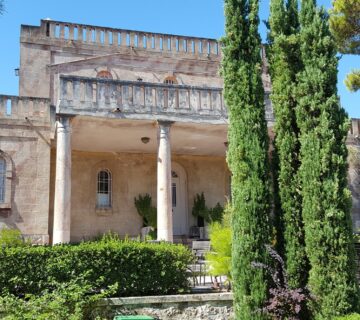
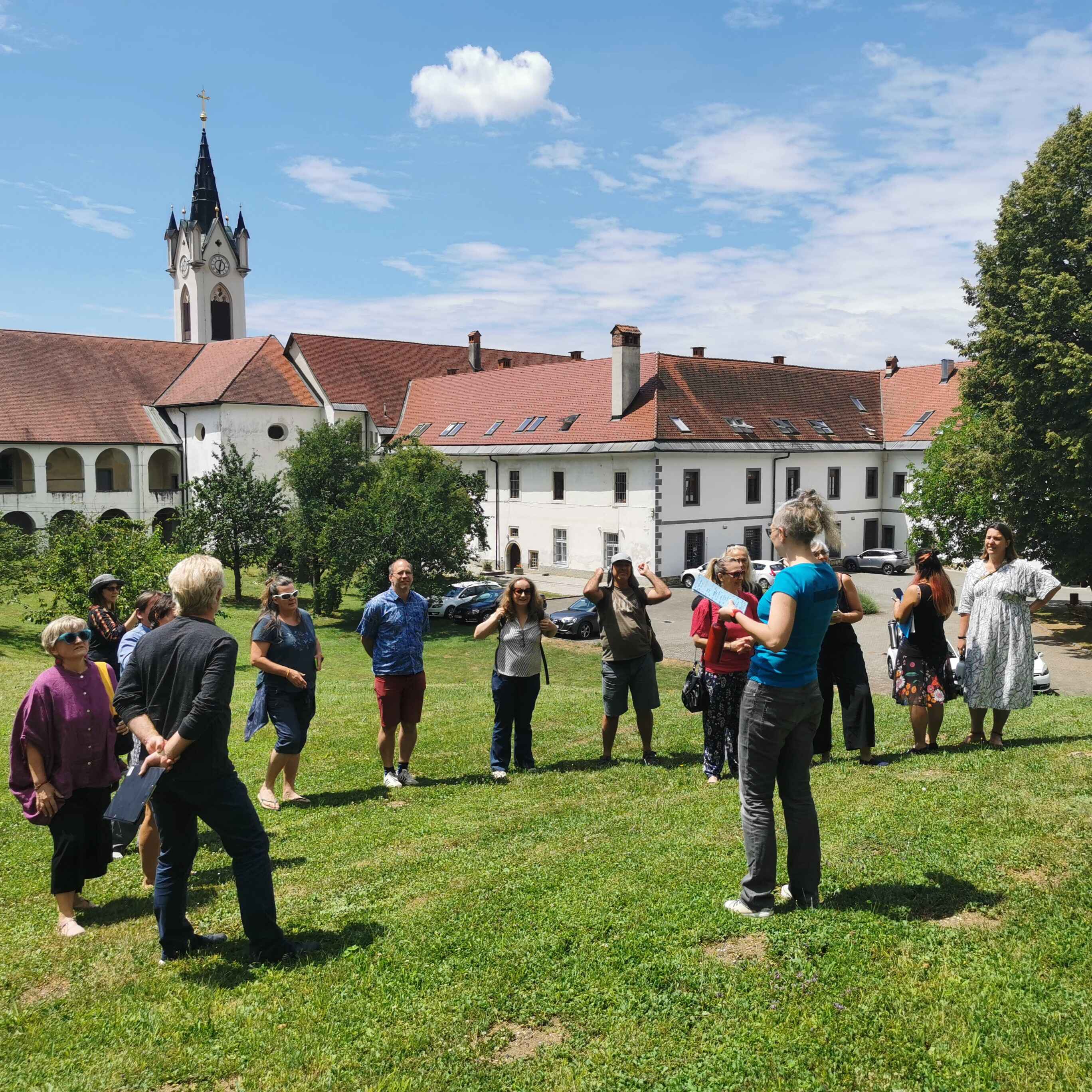
This year’s IE trainer summer school took place from 4-7 July in Slovenia – and it turned into an exciting ride through more than 50 subjects.
The Training Team had discussed the event for several months. A former monastery in Mekinje, near Kamnik, appeared to be the ideal location for a retreat, the EU network grant enabled organisational support and reduced participation fees – but the team was still torn regarding the programme’s structure.
On the one hand, there was a desire to announce a wide range of offerings to the trainers. On the other hand, the trainers had to become aware that they needed to take more responsibility to keep the IE training programme alive with almost no financial means; and then there was also an urgency for all to become more familiar with the participatory methods that have been incorporated into all IE certification courses since the 2022-23 review of the IE training programme.
The final decision was made only shortly before the summer school began. 25 trainers had registered, and the programme would be developed almost entirely by them. After their arrival, trainers were asked to write their suggestions on colour-coded facilitation cards. The colours distinguished between theory, exercises, workshops, open discussions and ‘desires’, i.e. topics trainers simply wanted to address or learn about from one another.
Expectations ranged from very high to fears that not enough proposals would be gathered. In fact, the Training Team held their breath while the courtyard filled with cards. Trainer after trainer presented their proposals – and there seemed to be no end to them. Finally, more than 50 suggestions were clustered and arranged into colourful thematic blocks to be implemented during the following days.
It would be presumptuous to claim that everything went perfectly well. Anyone wishing to learn through hands-on experience how to avoid mistakes in planning and facilitation certainly had the opportunity to do so. However, while there was no shortage of subjects, the challenge lay more in bringing the various sessions to clear conclusions and to document the results. Since parallel sessions were to be avoided whenever possible, one trainer handed over to the next without significant breaks – and the consistently high standard maintained throughout was an impressive proof of our trainers’ versatility and expertise.
On the last day, the group left ‘their monastery’ and was ‘catapulted’ via cable car up to Velika planina, a mountain plateau at 1,500m, characterised by alpine pastoral farming, where the trainers carried out interpretive exercises and freed their minds while hiking together in the fresh mountain air.
The summer school concluded with a guided walk through the old town of Kamnik, led by a local guide who immigrated from the USA and suggested that this was the town with the highest density of breweries in the world relative to its population. Consequently, the summer school wound down in one of Kamnik’s beer gardens…
The group concluded that, especially in times of increasing online meetings, there is hardly anything more enjoyable and more important for strengthening the bonds than an in-person meeting over several days.
In the final circle, the trainers from Hungary announced that the next summer school will take place in June/July 2027 in Szombathely – close to the Austrian border, where the 2018 IE conference was held. I think it is safe to say that many of us are much looking forward to it.
Thorsten Ludwig is an interpretive trainer, planner and consultant based in Germany. He has run his own company, Bildungswerk interpretation, since 1993. You can contact him at: ludwig@interp.de.
To cite this article: Ludwig, Thorsten (2026) “Is it possible to co-create a summer school?”, Interpret Europe Newsletter Summer 2026, pp. 13–14. Available online: Interpret Europe Newsletter Summer 2026.