What happens when heritage centres are built for inauguration day, while interpretation, staffing and long-term care are left for later?
I have always been fascinated by Joseph Conrad’s Heart of Darkness, and during those years I often thought of Charles Marlow. Eventually I began to suspect he had been lucky: he only had to travel up the Congo. I entered newly opened buildings presented as models of modernity only to find, a few metres further in, situations whose logic was harder to accept. Working in design direction and exhibition design, I moved through budgets, contracts, architectural decisions and content commissioned far too late, increasingly aware that every project seemed to contain its own Kurtz hidden behind an explanatory memorandum.
I experienced at first hand Spain’s boom in interpretation centres from the late 20th century into the first decade of the 21st. European funding accelerated their spread, while heritage offered an almost unassailable justification under the language of culture and conservation. Yet visitors too often occupied a secondary place. It is difficult to separate this proliferation from Spain’s wider construction boom. Alongside housing developments, auditoria and conference centres, cultural facilities multiplied within the same political ecosystem. Not every centre was unnecessary, nor every project speculative, but public works had become a privileged form of intervention. A building could be measured, budgeted and inaugurated; interpretive strategy and sustained relationships with audiences were less comfortable territory for an administration accustomed to square metres and technical specifications.
The European Regional Development Fund (ERDF) cultural categories for 2007–2013 reveal the imbalance. Spain programmed €346.6 million across three specifically cultural categories: 78.2% for heritage protection and conservation, 20.9% for cultural infrastructure and barely 1% for improving cultural services. Rounded figures may, therefore, total slightly above or below 100%. The material dimension absorbed almost the entire allocation.
That imbalance was visible in practice. Buildings were often designed as autonomous objects, with exhibition requirements considered later. The consequences were familiar: costly alterations to technical floors, insufficient power and data connections, spaces that could not be properly darkened, fragmented routes and lighting fit for cleaning but almost useless for controlling reflections or creating atmosphere. Exhibition design arrived afterwards and had to survive inside a building that had already decided almost everything without it.
The central questions should have come first: what are we trying to say, to whom, and what should visitors understand or discover? Instead, the container existed first, then came screens, showcases, models and projectors, and only afterwards the search for content capable of justifying them. It was rather like shooting the film first and trusting someone to write the script afterwards.
Carolina Martín-Piñol’s 2013 Manual del centro de interpretación (Manual of the Interpretation Centre) later gave systematic form to many of these concerns: conceptual ambiguity, weak regulation, inconsistent models and management problems. Bureaucracy reinforced them by commissioning communication through procedures designed for works and supplies, specifying panels and projectors while leaving audiences, narrative hierarchies and interpretive objectives unresolved.
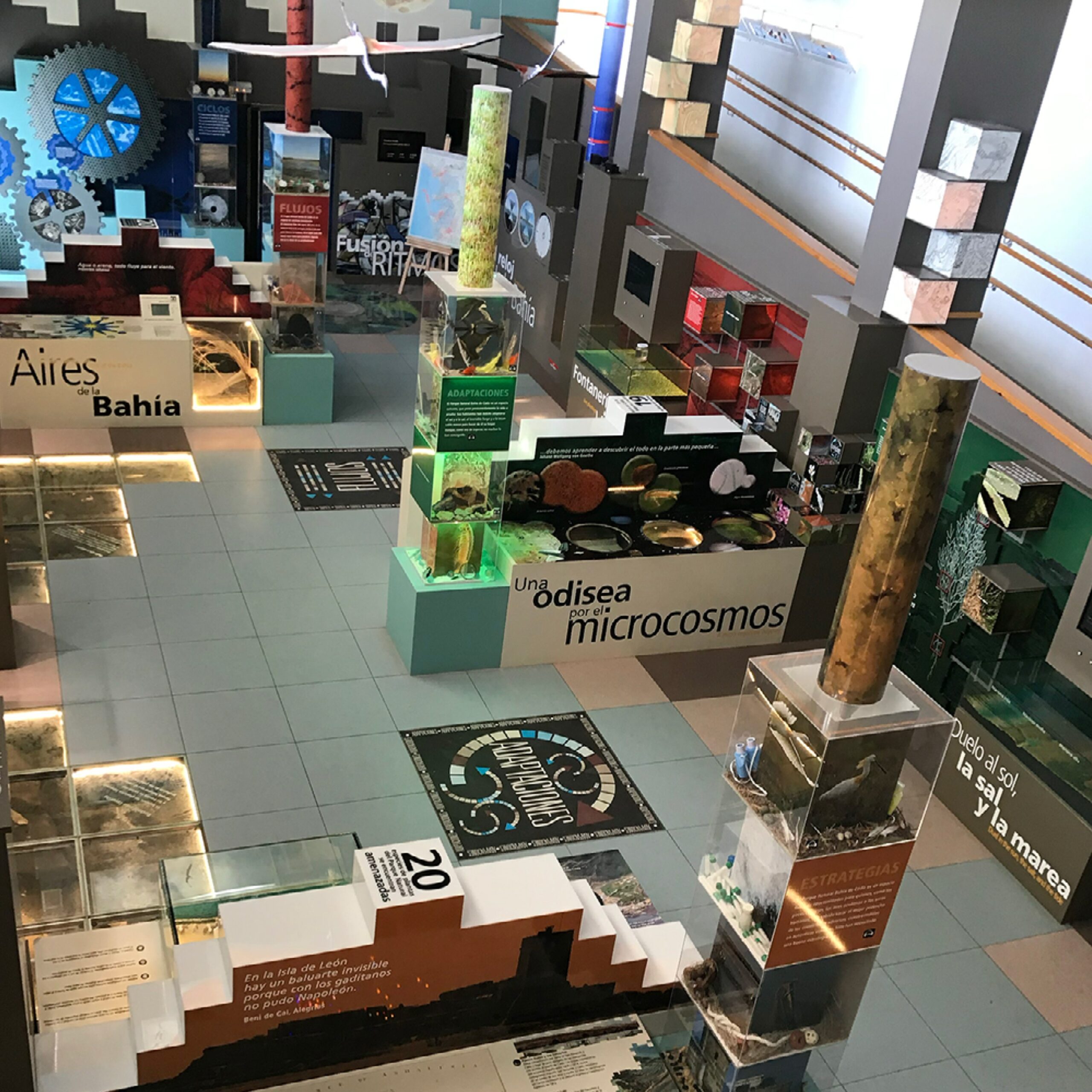
Freeman Tilden’s 1957 principles remain valuable, particularly his insistence on revealing relationships rather than merely supplying information. Problems arose when they became a self-sufficient theory. Communication had changed: visual narrative, spatial argument, audiovisual culture, interaction and digital environments demanded more than a linear transfer of knowledge. Too many centres filled walls with information while offering few reasons to want to understand it. The system’s weakness became clearest after inauguration. In Huerta Grande, Vejer, Tarifa, Pujerra, Chiclana, Jimena and Casares I encountered variations of the same pattern: centres opened “to see who turns up”, restricted hours, intermittent closures, changing management, incomplete documentation, outdated content and equipment left out of service. Some have become an involuntary archaeology of that policy, with decaying panels, dead projectors, obsolete computers and broken furniture.
A sample of 21 Andalusian projects between 2005 and 2015 totals about €11.66 million in documented expenditure: 50.9% for exhibition design and equipment, 41.1% for construction and barely 8% for content and interpretation. Cádiz Prehistórico was tendered at €1 million with 75% ERDF co-funding; the Baelo Claudia contract was awarded for €1.3 million (€1,301,000), also with 75% ERDF co-funding; and the Vía Verde de la Sierra Interpretation Centre was awarded €239,834 within a programme co-financed at 70%.
The European comparison is equally revealing. Cultural services represented 32.5% of the three cultural categories in Italy, 14.3% in France, 13% in Portugal, 11.4% in Germany, 7.5% in Poland and 6.2% in the United Kingdom. Spain stood at 1%, while allocating 78.2% to heritage protection. This does not measure interpretive quality, but it shows that Spain’s material emphasis was not inevitable.
The deeper problem was an administrative culture that found it easier to finance objects than processes and too often confused infrastructure with a cultural project. Some centres remain open; others struggle or have closed. Their empty rooms and silent machines now offer an interpretation nobody designed.
Perhaps the real measure of this neglect lies not in closed centres or millions spent, but in what we failed to explain while pretending to interpret it: environmental degradation hidden beneath reassuring language; the technocratic emptiness of terms such as Natural Park or ‘sustainable’, whose ambiguity José Manuel Naredo has long exposed; the consequences of the 1977 Amnesty Law for investigating grave human rights violations; or the fact that many Andalusians know Blas Infante only as a ceremonial name, without knowing what he defended, why he was dangerous to those who rose in 1936, or why he was shot beside the road to Carmona.
A territory can fill itself with centres devoted to its heritage while forgetting where it came from, what happened there and who paid with their lives for imagining another Andalusia. While the stars wept.
The full version of this article, in English and Spanish, is available on My Lazaretto: https://mylazaretto.blogspot.com.
Juan José Trujillo Reyes is a Spanish creative and editorial director specialising in exhibition design, heritage interpretation, visual communication and data visualisation. He is Creative and Editorial Director of OTWO magazine dedicated to sustainable travel and nature (www.otwomag.com), and is the author of My Lazaretto, a blog dedicated to design and contemporary thought. He can be contacted at: juanjo.trujillo@gmail.com.
To cite this article: Trujillo Reyes, Juan José (2026) “The heart of the cultural facility, after Conrad”, Interpret Europe Newsletter Autumn 2026, pp. 6–8. Available online: Interpret Europe Newsletter Autumn 2026.