They are great partners for implementing heritage interpretation in all countries and offer some prospects for cooperation.
In 2024, IE had the opportunity to conduct a two-day in-person workshop for the Austrian Commission for UNESCO in Vienna. The focus was on World Heritage interpretation. The German Commission for UNESCO took up this format, and since then IE has conducted three more workshops of this kind.
The workshops were prompted by the five recommendations on value-based heritage interpretation issued by the UNESCO Regional Bureau for Science and Culture in Europe after its 2019 workshop in Bamberg, Germany. These recommendations were included in the regular reviews of the IE training programme, which culminated in the joint Learning Landscapes initiative between IE and the Regional Bureau.
Beyond presenting facts and meanings, the aim is to foster interpretive literacy among people. Visitors and local people around heritage sites are encouraged to share their own interpretations and the underlying values associated with them, while also ensuring that such processes are properly facilitated. Local stakeholders are supported in developing interpretive strategies together, and local guides, writers, and planners are to be given the opportunity to undergo relevant training and obtain certification.
During the workshop, we conducted exercises aimed at initiating whole interpretive experiences, linking heritage with values at varying levels, and identifying phenomena particularly suited to addressing sustainability in a way that opens access for people who are perhaps not initially interested in the topic.
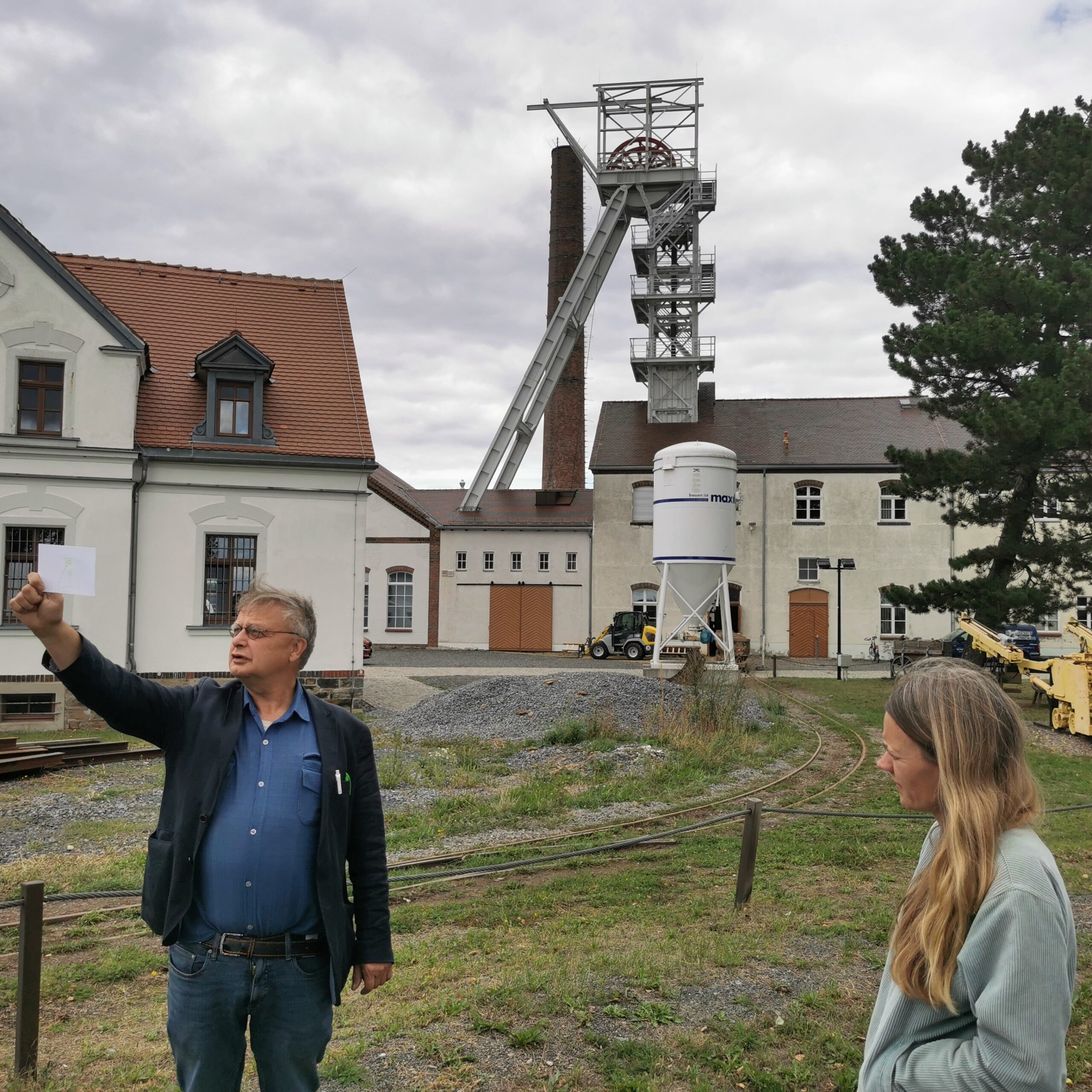
As with all German UNESCO workshops, the event was initiated by Carolin Kolhoff, Head of the Division of World Heritage at the German Commission for UNESCO. This particular workshop was organised by Katharina Jesswein, Project Manager for Education and Mediation at the serial German-Czech World Heritage property Erzgebirge/Krušnohoří Mining Region. Hence, it also included a memorable descent into a mine shaft, where our hosts introduced us to an interpretive trail at a depth of 150 metres.
As a next step, heritage interpretation will now be the subject of the German Federal Foreign Office’s regular online World Heritage Exchange. IE has just been invited to present the latest developments there, and participants from the previous in-person workshops will contribute by sharing activities resulting from them.
Furthermore, the Regional Bureau in Venice has initiated a two-day online symposium, scheduled for February, to familiarise all serial World Heritage properties in Europe with the new developments.
What can you do now?
National Commissions for UNESCO exist in all countries, serving as platforms between the UNESCO headquarters in Paris, the respective national government, and the civil society. You can find the contact details at https://pax.unesco.org/countries/NationalCommissions.html.
It would be highly desirable to reach out to commissions in more countries. Of course, this primarily calls for action from country coordinators and their teams, but also from other IE members, especially institutional ones, who may already have good contacts. Perhaps you might then be able to report on a workshop held in your country in a future newsletter.
Thorsten Ludwig founded his company, Bildungswerk Interpretation, in 1993. He holds an MSc in Interpretation: Management and Practice, was awarded for the ParcInterp training project as part of the UNESCO Decade Education for Sustainable Development and, in his former role as IE Managing Director, received the EU Altiero Spinelli Prize for the initiative Engaging citizens with Europe’s cultural heritage. You can contact him at: ludwig@interp.de.
To cite this article: Ludwig, Thorsten (2026) “Could you reach out to your national commission for UNESCO?”, Interpret Europe Newsletter Autumn 2026, pp. 15–16. Available online: Interpret Europe Newsletter Autumn 2026.