Shifting paradigms in heritage interpretation, in the light of Faro.
You know that feeling… when you walk into a dark room and you can’t see anything? Then someone lights a small candle. Not to show you the whole room. Not to give you all the answers. Just enough light so you know you are not alone.
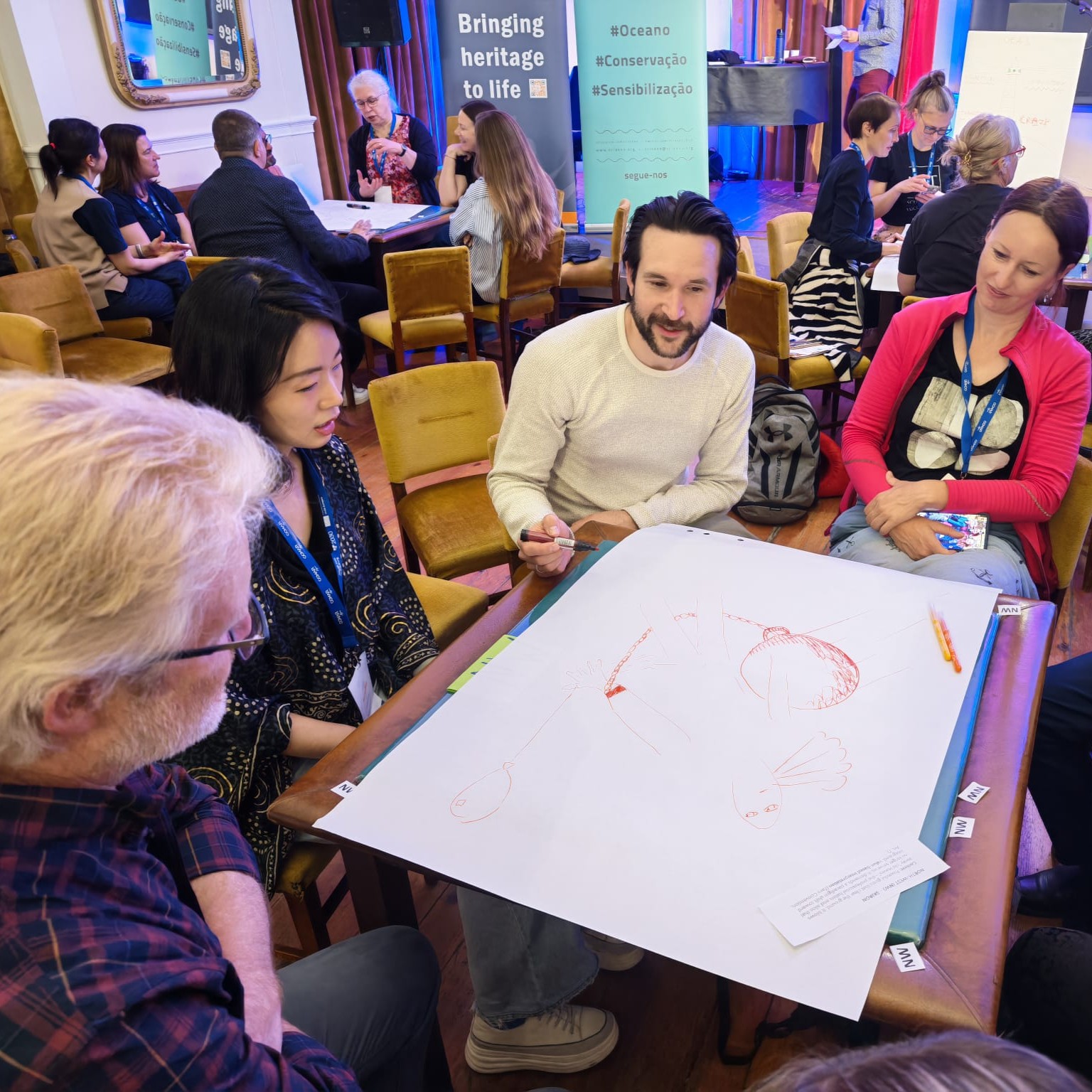
This was the spark that ignited the final session of the IE Conference 2026, where we gathered under the title, Re-interpreting heritage in the light of Faro. But this New Paradigm Cafe was much more than a traditional wrap-up. Eight groups, eight tables, one morning. It was a live, collective creation and one of the crucial first steps in a much longer journey toward building Interpret Europe’s new Framework of Reference. We didn’t come to listen to lectures. We came to talk, to argue, and most of all, to listen to each other. Anchored in the Faro Convention. Driven by its spirit.
We didn’t come to Faro to stay safe. We came to set sail. Like the Portuguese navigators: Gil Eanes, Vasco da Gama, Magalhães. No perfect map. Just a brave heart. And each other.
Under the banner of ‘The Winds of Faro’, the eight working groups actively gathered raw ideas, insights, and perspectives to feed into this new process. We learned that co-creation matters more than delivery, and that visitors want authentic experiences rather than official stories. We talked about brave environments instead of safe spaces. Safe can be too still, too quiet. Brave is alive, messy, and open to change. Disturbance, we realised, is not a problem. It is a chance to adapt. The core? Trust. Love. Respect. And gentle humour.
We drew a red line. All opinions are welcome, but when human dignity is attacked, we do not stay quiet. We take a stand. Pushing our values onto others is still colonisation, even when we mean well. We faced the heavy stuff too: guilt, lies, and difficult history. We learned to move from guilt to acceptance, and from acceptance to making things right. It’s not about whose story wins. It is about relationships.
Then came the idea of empathy as a vaccine. If 85% of people in a community truly care, the whole community becomes immune to hate. Not conflict-free, just immune to hate. And that, we agreed, is enough. This changes how we see the interpreter. Not an expert on a hill with ready-made answers or narratives, but a listener, a mediator, a host. Someone who builds trust over time, reacting to the community instead of lecturing it.
Eight winds. One direction. Stay in conversation. Build relationships. Strive for empathy.
This collective effort brought us directly back to the heart of the Faro Convention through the words of Amra Hadžimuhamedović, one of the key experts behind the Convention and one of our keynote speakers at this conference. She reminded us of a vital truth: if heritage is a resource, it is a resource for peace. Not for tourism. Not for money. Peace.
Reflecting on more than two decades since she helped shape the convention, she invited us to go a few steps further, expanding our relationship with heritage into something more holistic, balanced, and responsible. This relationship reaches its true meaning only when we also embrace the planet and the children we will never meet. All of it belongs together.
The new Framework of Reference will not be written behind closed doors. The invaluable raw material gathered in Faro is just the beginning of a broader collaborative effort that will continue through dedicated working groups and deeper analysis. But it proved that our members are ready to share the weight of this journey. Because the best heritage interpreters don’t tell you what to see. They show you where to look.
Dubravko (Max) Fijacko is Interpret Europe’s Outreach Coordinator and is an active Interpret Europe trainer. He can be contacted at: dubravko.fijacko@interpret-europe.net.
To cite this article: Fijacko, Dubravko (Max) (2026) “iecon26 wrap-up”, Interpret Europe Newsletter Summer 2026, pp. 7–8. Available online: Interpret Europe Newsletter Summer 2026.