How the Lukashenko regime turns school history into a weapon of authoritarian survival, and what the 2020 protests revealed about its limits.
Contemporary heritage interpretation rests on the conviction that the past is best engaged through multiple voices, open dialogue, and inclusive narratives. But what becomes of this vision in an authoritarian state, where engagement with history is treated as a strictly controlled political resource?
This article examines how the Belarusian regime under Alexander Lukashenko has, over three decades, turned the history classroom into an instrument of authoritarian survival. Drawing on a longitudinal discourse analysis of four state-mandated history textbooks published between 2006 and 2019, it traces how heritage interpretation can be inverted: instead of opening the past to dialogue, it is sealed off to silence dissent.
Three mechanisms stand out.
First, the textbooks rely on strategic lacunae (gaps). Stalinist repressions are paradoxically depoliticised. The famine of the 1930s is erased. The democratic transition of 1991–1994, including Lukashenko’s contested rise to power, simply disappears: the 1994 Constitution appears out of nowhere, and his rule begins as a natural, uncontested historical destiny. Through such omissions, the curriculum purges the past of any element that might suggest alternative political possibilities.
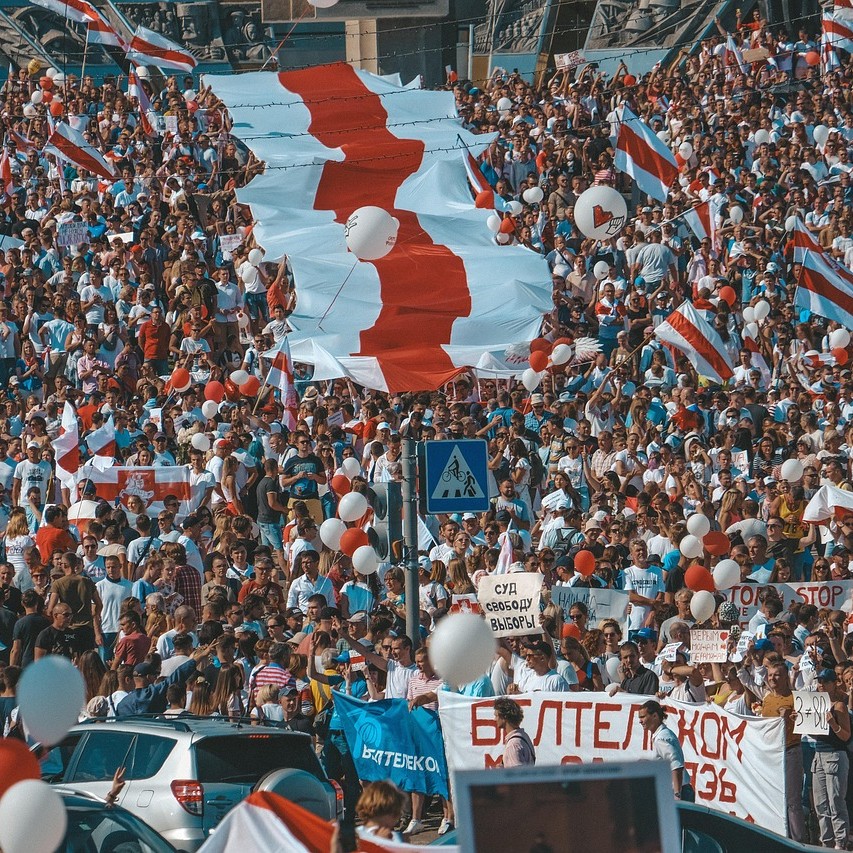
Second, the textbooks weaponise heritage symbols against contemporary opposition. The white-red-white flag and the ‘Pahonia’ coat of arms — historic Belarusian emblems and banners of political resistance — are systematically linked in textbooks to Nazi collaboration. The educational narrative laid the legal and moral groundwork for the regime’s later official ban of these symbols as ‘extremist’. Heritage is reframed not as inheritance, but as evidence in a political trial.
Third, the regime extends this work from the printed page into physical space. ‘Lessons in a museum’, and the spatial organisation of state exhibitions constructs what may be called a ‘route of loyalty’: a curated pathway dictating the boundaries of acceptable memory. Classrooms and museums cease to function as sites of inquiry and become sites of loyalty enforcement.
Yet this monopoly carries its own vulnerability. The unprecedented civic protests of 2020 — in which the ‘Pahonia’ and the white-red-white flag returned as symbols of mass resistance — revealed that a narrative stripped of trauma, complexity, and citizen agency cannot indefinitely contain the lived reality of those it claims to represent.
For heritage interpreters, the Belarusian case is a cautionary one. Multiperspectivity, plural memory, and dialogic interpretation are the practical safeguards against the political capture of the past.
Nikolai Shpilkov is an independent journalist and historian. A former PhD student in Russia, he left the country in 2022 and is now completing an MA at the University of Siena, Italy, while seeking a PhD position to continue his research on Belarusian memory politics. Nickolai can be contacted at: nickolay.rayskiy@outlook.com.
This article is a summary of a longer paper, which was presented at the Interpret Europe online symposium, The role of narratives in 21st century heritage interpretation. The full paper can be found in the proceedings: https://interpret-europe.net/wp-content/uploads/2026/06/ie_online_symposium_2026_proceedings_2nd_ed_compressed.pdf
To cite this article: Shpilkov, Nikolai (2026) “Weaponising the past in Belarusian schools”, Interpret Europe Newsletter Summer 2026, pp. 29–30. Available online: Interpret Europe Newsletter Summer 2026.