A school journey using heritage interpretation to turn a familiar neighbourhood into a field of stories and meanings.
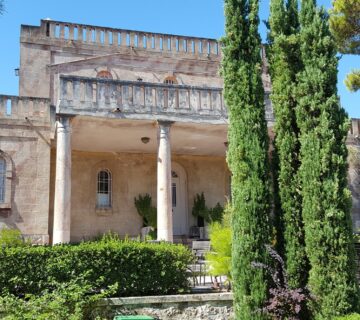
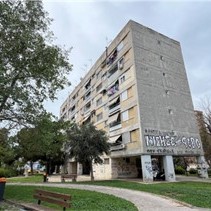
Heritage interpretation often reaches schools through museums and organised visits to monuments, where students encounter interpretations prepared by others. This project began closer to home: in Tavros, a neighbourhood of Athens shaped by refugee settlement, industrial activity and social housing. Working within the Greek Skills Workshops curriculum, Grade 9 students of the 1st Junior High School of Tavros were invited to explore the stories of their neighbourhood and transform their own interpretations into a podcast.
“Boring”, “ugly”, “a place everyone wants to leave”: this was where the project actually began. Most students’ first reactions revealed distance rather than connection. Instead of seeing this as a problem, we treated it as a call for interpretation. Could heritage interpretation help students connect with places they passed every day but had never really noticed?
Students explored archival material and oral-history testimonies related to local landmarks. They investigated stories of migration and urban change, and imagined the experiences of people who had lived and worked in the neighbourhood at different moments in time. Most importantly, they were encouraged to reflect on how these stories related to their own lives.
Gradually, familiar places began to look different. Apartment blocks, busy streets and public spaces started to carry memories, experiences and meanings. In classroom discussions, students negotiated different perspectives and constructed a shared narrative about the place they inhabit.
The process culminated in the creation of a student podcast, A Neighbourhood Unfolding, shared through the European School Radio network. Using voice, music and sound, students communicated their own interpretation of Tavros beyond the classroom, reaching both the local community and a wider audience. In doing so, they contributed to how their neighbourhood is perceived. The podcast was also recognised through the European School Radio contest process.
Seen through the lens of the Faro Convention, the project opens up a broader question about the place of heritage interpretation in formal education. Faro reminds us that heritage is shaped by the meanings people attach to places, stories and experiences (Council of Europe 2005). From this perspective, schools can become spaces where young people learn to recognise these meanings, connect them with wider stories and communicate their own perspectives.
In our project, heritage interpretation supported key learning skills: students worked critically with sources, but also imaginatively with stories. They collaborated to shape a shared narrative and then communicated it to audiences beyond the classroom. In this sense, when students are given opportunities to inquire, interpret and create, heritage interpretation becomes both a way of engaging with heritage and a way of learning.
This article is a summary of a presentation given at the Interpret Europe Conference 2026. The full paper with references can be read in the conference proceedings, available soon on the IE website: https://interpret-europe.net/material/
References:
- Council of Europe 2005, Council of Europe Framework Convention on the Value of Cultural Heritage for Society (CETS No. 199), Council of Europe, viewed 31 May 2026, https://rm.coe.int/1680083746.
- A Neighbourhood Unfolding, European School Radio, can be accessed here: https://europeanschoolradio.eu/episode/13362.
Evgenia Stavraki teaches mathematics at the 1st Junior High School of Tavros, Athens, Greece. She holds an MA in Museum Studies and an MA in New Technologies in Education, with a focus on STEAM education. Her interests lie in bridging heritage interpretation and formal education, exploring how culture and community can become creative spaces for communication and learning. She can be contacted at: eugenia.stav@gmail.com.
To cite this article: Stavraki, Evgenia (2026) “When heritage interpretation enters the classroom”, Interpret Europe Newsletter Summer 2026, pp. 26–27. Available online: Interpret Europe Newsletter Summer 2026.