A practical guide that reopens the debate on themes, expertise and AI, while offering tools every interpretive planner can use.
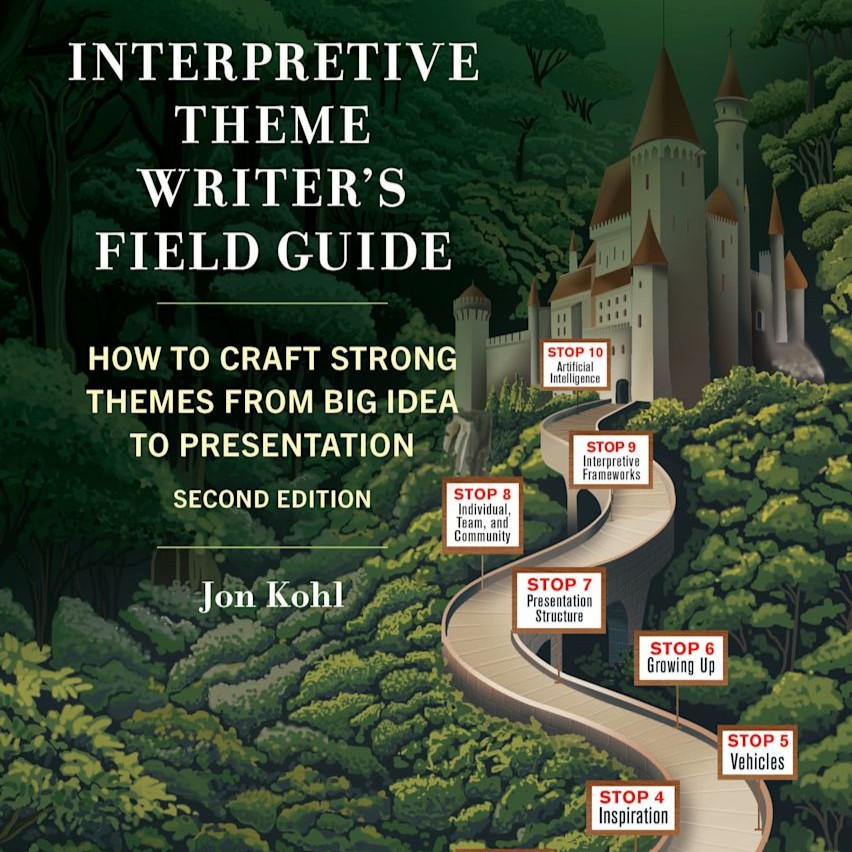
Jon Kohl’s Interpretive Theme Writer’s Field Guide, now in its second edition, is not just a book explaining why interpretation should be thematic. Subtitled, How to craft strong themes from big idea to presentation, it tackles a more practical question: How do we actually craft and deploy a strong interpretive theme?
Designed as a field guide rather than a theoretical text though it still offers extensive references from the interpretation and writing craft literatures, it combines concise explanations with exercises, worksheets, famous writing quotes, examples and critiques of real-world themes. It also features contributions from practitioners worldwide in the ‘Voices from the Field’ sections. You can find essays by IE members Thorsten Ludwig, Angela Pfenniger and Michael Hamish Glen.
For members of Interpret Europe, the timing is telling. Our professional conversations have shifted in recent years toward narratives, participation and co-creation, a shift explored at length during our online symposium in February this year on the role of narratives in 21st century heritage interpretation, which asked how narratives shape meaning, dialogue and responsibility, and why working with them has become a central task for interpretation today.
Kohl’s book arrives in the middle of that reflection, not outside it. He advocates that narratives do not exist without a theme structure, but that both can be the starting point for storytelling. Kohl embraces participatory approaches; in fact, he argues for ‘theme teams’ and community-based interpretive frameworks to help develop the ‘Big Idea’. But he insists participation does not replace professional expertise, and that a smaller professional group or individual still needs to shape the words that carry a shared idea. Whether a theme ever truly left the centre of planning, or only its authorship became contested, is itself part of the debate this book reopens.
One of its most valuable ideas is the distinction between primary and secondary audiences: a theme should first inspire those who create it, before being adapted for different kinds of visitors. It is a convincing defence of the interpretive planner’s role, not someone who imposes meaning, but someone who facilitates dialogue to identify a compelling ‘Big Idea’ and then refines it into a theme sentence. The book is process-driven and this idea was already in the first edition.
What the second edition genuinely adds are two new chapters: one on deriving presentation structures from themes, another on developmental psychology, a reminder that interpreters grow and change too which affects both the kinds of themes that they write and the kinds of themes different audiences can relate to.
The chapter on artificial intelligence (AI) deserves attention for its balance. Kohl treats AI as neither threat nor miracle, but as a tool that still demands critical professional judgement.
The question resonates well beyond this book: it ran through this year’s Interpret Europe trainers’ summer school, where Michal Medek facilitated an exchange ranging from skepticism to cautious optimism, alongside real ethical and sustainability concerns. Kohl has also conducted a separate study on the use of AI in interpretive theme writing, which will be the subject of a webinar on 13 October 2026.
Readers will not agree with every argument here, nor should they. Perhaps the book’s greatest contribution is that it keeps a debate alive rather than closing it, pushing us to keep refining both our thinking and our tools.
The book is available from the US National Association for Interpretation (NAI) and Bloomsbury Academic.
Vanessa Vaio is an IE certified interpretive planner and trainer and is IE’s Country Coordinator Italy. She has worked in heritage interpretation for more than 30 years, supporting museums, protected areas and UNESCO World Heritage sites across Europe. She can be contacted at: vanessa.vaio@interpret-europe.net.