
Reflecting on how live interpretation differs from performance, and why dialogue remains at the core of meaningful visitor engagement.
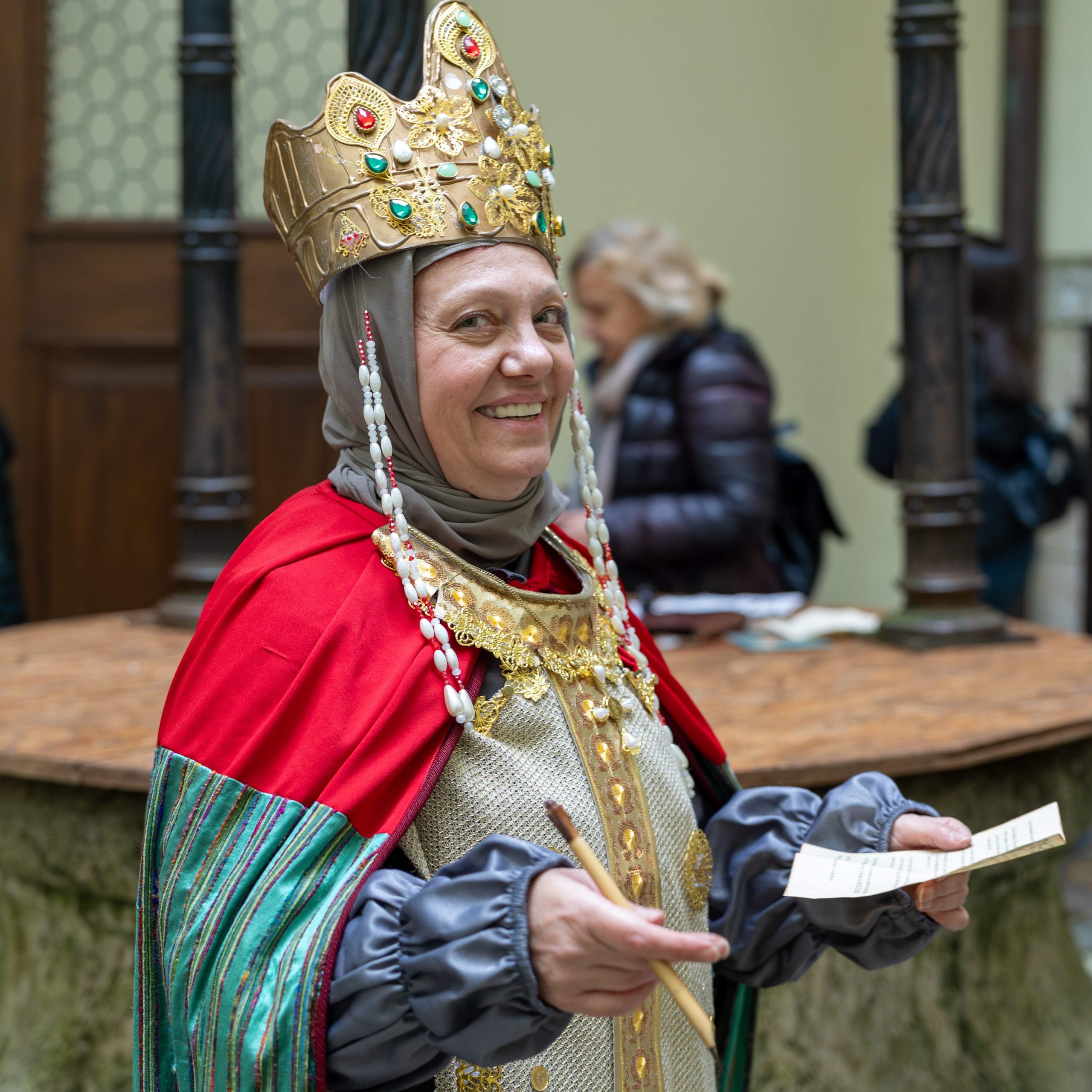
Retiring a costume can seem like a practical decision, but in my recent work it became a moment of deeper reflection on what distinguishes live interpretation from performance. I have embodied the medieval character of Queen Maria Palaiologina for several years, and placing her costume into archival storage allowed me to revisit the principles that guide our practice as interpreters.
The garment itself was originally designed for an AR/VR project, intended for a controlled digital environment rather than open-ended visitor interaction. Its theatrical qualities served well in virtual storytelling, but they were never meant for the dynamic, dialogic nature of live interpretation. Acknowledging this mismatch became a reminder of why our tools must support communication rather than simply visual effect.
Live interpretation, particularly when delivered through a historical character, is often mistaken for acting. Yet interpretation is not a performance presented to an audience. It is a facilitated process in which meaning is co-created with visitors. Actors are trained to project emotion outward; interpreters, instead, should cultivate a shared space where questions, curiosity and reflection shape the encounter.
This distinction is especially clear when working with visitors who arrive with diverse interests and expectations. Interpretation is interactive, and the interpreter must be prepared to respond to enquiries that go far beyond the surface of a costume or a storyline. Solid scholarly grounding is essential: visitors challenge, compare and explore, and the interpreter must offer context with accuracy and empathy.
Museum theatre provides an illustrative example. Although it borrows elements from theatre, its purpose is interpretive communication. Characterisation is used not to deliver a scripted narrative, but to open a dialogue about heritage. Visitors are not passive observers but participants whose perceptions actively shape the experience. Actors can become excellent interpreters, but they require training in interpretive methodology to shift from performance to engagement.
Working with Queen Maria Palaiologina’s costume has given me opportunities to explore how embodiment can reveal connections between past and present. Through dialogue, visitors often move from the personal story of a medieval noblewoman to questions of identity, cultural exchange and the role of women in historical decision-making. These conversations demonstrate how interpretation fosters both emotional resonance and intellectual insight.
The retirement of her costume is not an ending but a transition. The interpretive themes remain alive, and the character continues to serve as a bridge to wider historical reflection. What changes is the medium through which the dialogue is facilitated.
Ultimately, this moment reinforced a core principle of our profession: interpretation is defined not by costumes or props, but by the shared meaning created between interpreter and visitor. When that dialogue is authentic, the story endures long after the garment is set aside.
Vasilka Dimitrovska is an IE trainer for the Certified Live Interpretation course. She is the founder of Kreaktiva – The Storytelling & Experience Design Studio, and Creative Director of HAEMUS. She specialises in experience-based approaches to bringing heritage to life. Vasilka can be contacted at: info@kreaktiva.mk.
To cite this article: Dimitrovska, Vasilka (2025) “When a costume retires: Rethinking live interpretation”, Interpret Europe Newsletter 4‑2025, p. 23-24.
Available online: Newsletter winter 2025