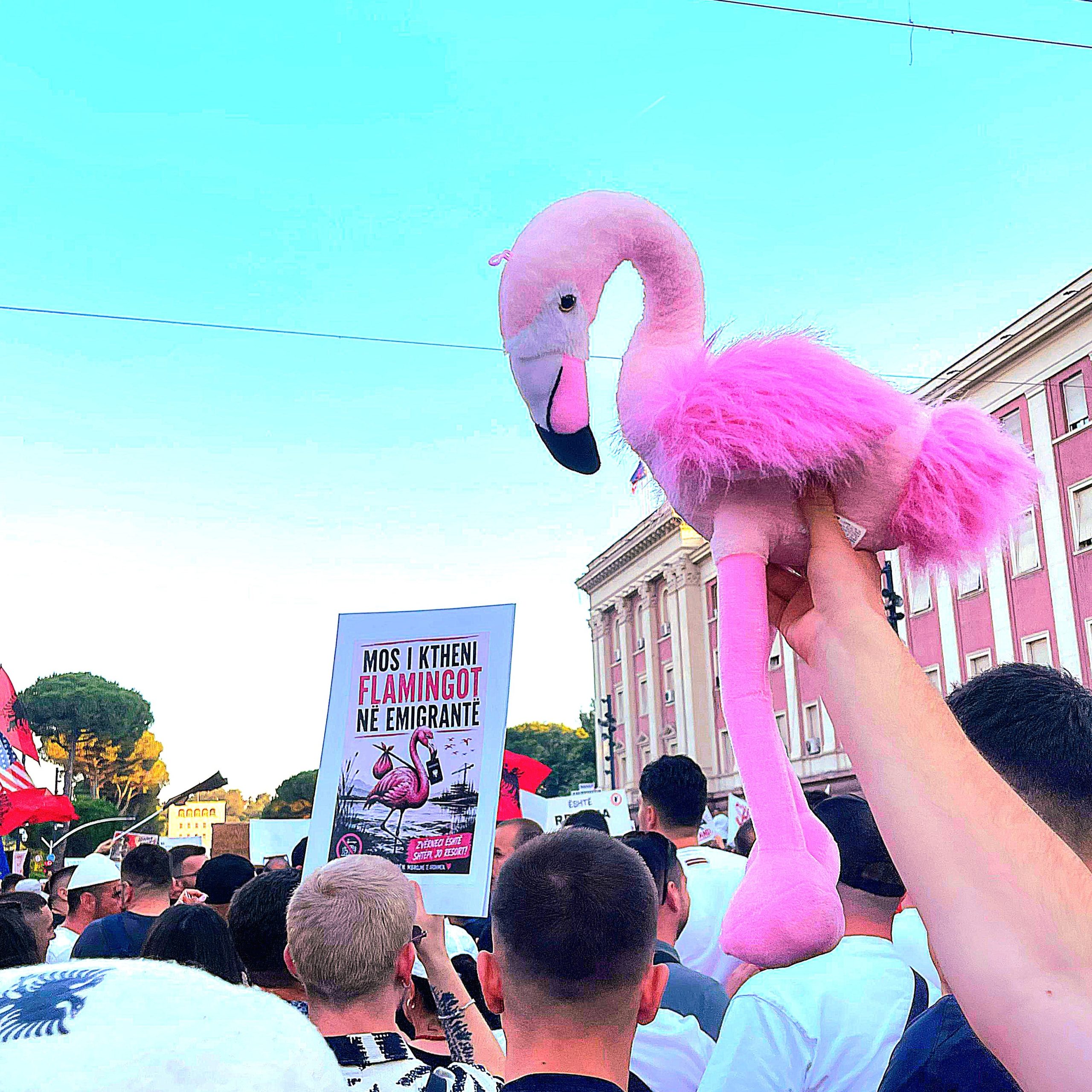
Pretty pink protests are raising awareness of unsustainable tourism development on protected habitats.
For more than 25 years, I have worked in environmental education in Albania. In the early years, whenever we designed a project, donors would ask the same question: What will be the outcome?
The answer is not always easy to measure. How do you measure a child’s first understanding that a wetland is alive? How do you measure a teacher who begins to include nature in a lesson plan? How do you measure the moment when a young person stops seeing a protected area as empty land and starts seeing it as heritage, responsibility and identity?
Today, on the streets of Albania, I feel I am finally seeing one of those outcomes.
In recent days, young people, many of them belonging to Albania’s Gen Z, have joined public protests in defence of protected areas, especially around the Vjosa-Narta landscape and the planned luxury tourism development near the sensitive coastal wetlands. The flamingo has become one of the symbols of the protest. Pink inflatable birds, handmade posters and sharp, simple messages have filled the streets. Behind the humour and colour, there is a serious demand: Protected areas must remain protected.
This is not only an environmental protest. It is also a civic lesson taking place in a public space.
Albania has made important progress in recognising its natural heritage. Areas such as Vjosa, Narta, Divjaka-Karavasta, Prespa and many others are not just beautiful landscapes. They are living classrooms, migration routes, habitats, and memory places. They connect biodiversity with local communities, stories, livelihoods and culture.
But protected areas in Albania are now under pressure. Amendments to the Law on Protected Areas, approved in 2024, have been strongly criticised by environmental organisations because they open the door to large-scale development inside areas that were previously intended to benefit from stronger protection. Conservation groups have warned that projects in sensitive zones, including the Vjosa-Narta area, could damage habitats for flamingos, sea turtles, monk seals and many bird species. International attention has also grown, with concerns linked to Albania’s path toward alignment with EU environmental standards.
For me, the most powerful part of this moment is not only the legal debate. It is the faces of the young people in the crowd. Many of them were born after the first wave of environmental education projects began in Albania. They grew up with recycling days at school, nature clubs, field visits, campaigns, posters, clean-ups, biodiversity lessons and outdoor activities led by teachers and civil society organisations. Some of these activities were small. Some lasted only a few months. Some were funded by donors who needed indicators, reports and final evaluations.
But something remained.
A vocabulary remained. A sense of care remained. A belief persisted that nature is not a luxury and that development cannot mean sacrificing everything that makes a place unique.
This is why I see the current protests as more than resistance. I see them as interpretation in action. Interpretation is not only what happens at a visitor centre, in a museum, on a trail or beside a monument. Interpretation also happens when people connect meaning with place. It happens when a flamingo is no longer just a bird, but a messenger. It happens when a wetland is no longer just a map category, but part of a shared future. It happens when young people take scientific facts, personal emotion and civic courage and turn them into a public voice.
For many years, environmental educators in Albania have tried to help people understand that protected areas are not barriers to development. They are a different model of development. They protect water, soil, birds, landscapes, local economies and cultural identity. They give communities the chance to build tourism that respects place, rather than consuming it.
The young people in the streets seem to understand this very clearly. They are not against Albania’s progress; they are asking what kind of progress we want. They are not against tourism; they are asking whether tourism should destroy the very nature that attracts people here. They are not speaking only for birds and wetlands; they are speaking for public trust, transparency and the right of future generations to inherit more than concrete.
As someone who has spent more than a quarter of a century working in environmental education, I feel pride, but also responsibility. Pride, because I can see that education has roots. Responsibility, because this moment reminds us that education must not stop at awareness. It must grow into participation.
The lesson from Albania today is simple and deeply important for all of us working in heritage interpretation: When people truly understand the value of a place, they are more likely to defend it. For years, we planted small seeds in classrooms, youth camps, teacher trainings, and community projects. Now, some of those seeds are standing in the streets, holding flamingos above their heads. And for the first time in a long while, amid all the concern, I feel hope.
Daniela Ruçi has worked for many years as an environmental education expert for sustainable development, and she is passionate about the effective use of heritage interpretation to engage the next generations. Daniela is Interpret Europe’s Social Media and Design Officer. She can be contacted at: daniela.ruci@interpret-europe.net.
To cite this article: Ruçi, Daniela (2026) “When flamingos took to the Albanian streets”, Interpret Europe Newsletter Summer 2026, pp. 24–25. Available online: Interpret Europe Newsletter Summer 2026.