There is nothing so practical as a good theory.
The work that heritage interpreters may be expected to do is growing broader and more complex. For example, in the past century it was usually left to them to come up with interpretations and ways to engage visitors. Today, interpretations of any given heritage are often publicly contested. To develop or revise interpretive offerings, heritage professionals may find themselves working with local communities, special stakeholders, political representatives, and a wider public.
The core skills of the heritage interpreter, as taught in Interpret Europe’s certification courses, remain valid. But to stay on top of the ongoing expansion of their field, heritage interpreters need to grow their skill set. They also need to develop an adequate theoretical understanding of their professional practice in this century. I don’t mean theory for theory’s sake, or for scoring status points with academic snobs. I mean the kind of theory that helps you be good at what you do, just like a good hiking map makes it easier for you to navigate the terrain.
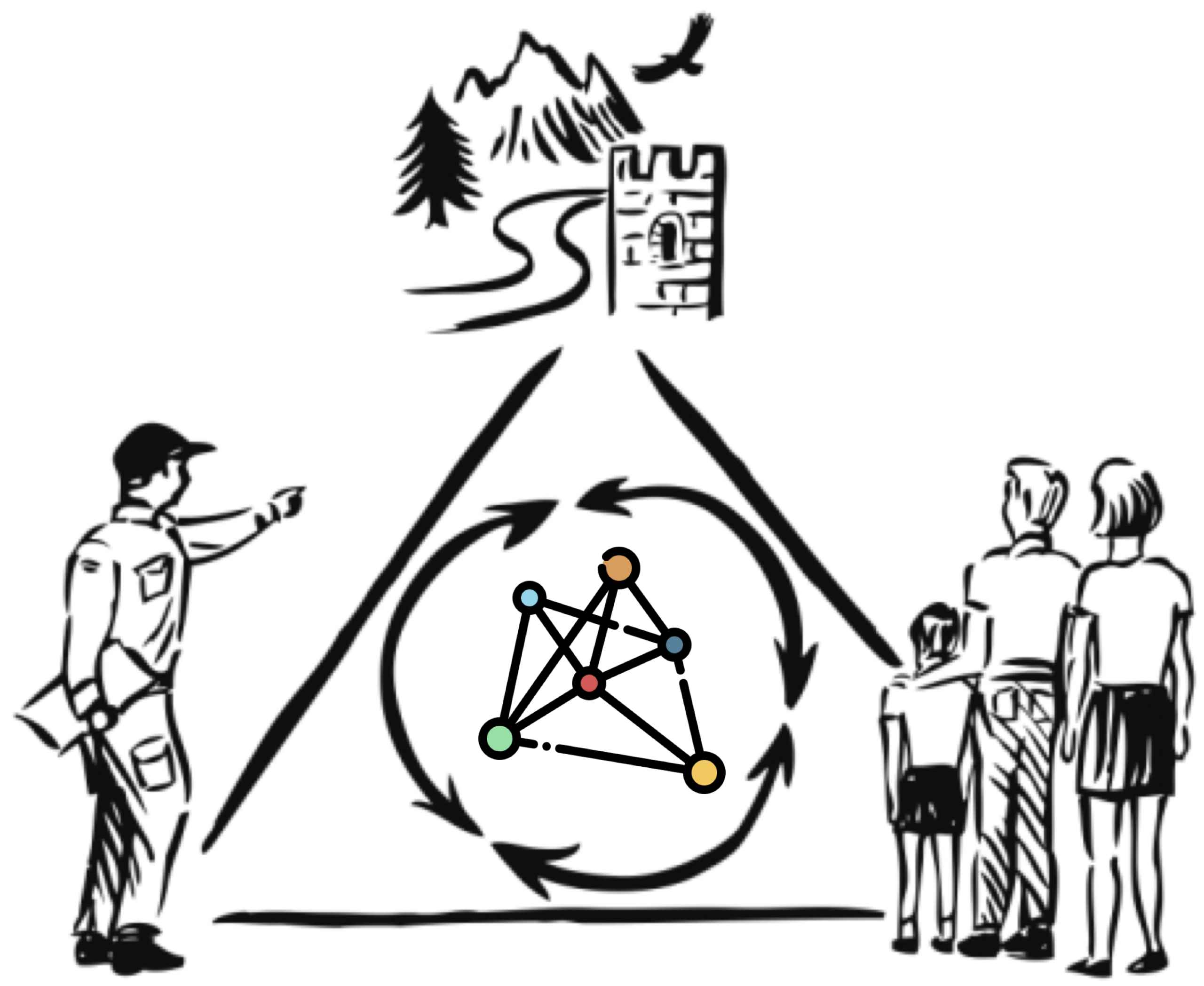
Between practical skills and theoretical understanding, developing the latter could turn out to be the greater challenge, given that we may still lack any adequate theory of heritage interpretation, for this century or the last. To provoke ideas and responses, in the spirit of brainstorming, let me make an easy fresh start based on a connective concept, specifically the concept of mental modelling. It captures the notion that we understand the world by creating models of it in our minds, including models of heritage phenomena.
A connective concept, as I understand the term, is a concept that connects an initially disparate set of concepts, theories, or conversations. One thing that a good connective concept for heritage interpretation would do is to help us make coherent sense of the growing professional vocabulary. We would be able to define most of our terms with reference to such a connective concept. This has the useful effect of making it quite obvious how our terms, concepts, and perhaps even existing theoretical approaches relate to each other.
As a small test, let us consider some terms highlighted by the Interpret Europe online symposium held in February 2026. The symposium reflected on the role of ‘narratives’ in current heritage interpretation practice. A number of other relevant terms were collected in the symposium materials and Thorsten Ludwig’s introductory talk. Below I define some of them with reference to the concept of mental modelling:
Frame. Mental model that acts as a mould for other mental models.
Interpretive theme. Mental model that an interpreter uses as a mould to shape the mental model of a given phenomenon; in other words, a kind of frame.
Narrative. A large frame [mental model that acts as a mould for other mental models]; also, specifically, a large-scale story [mental model that describes a process] that acts as a frame.
Story. Mental model that describes a process.
Brain script. Mental model of how to act in a given situation; in other words, a template story [mental model that describes a process].
Take a moment to let this test example sink in. When you have, I hope you can agree that the concept of mental modelling lends itself quite easily to defining at least some of the vocabulary of heritage interpretation. What is more, with mental models as a common denominator, connections immediately begin to appear between individual terms, binding them together in a crisscrossing web of meanings. This is a promising start for the development of a new working theory.
Where do we go from here? Staying with the concept of mental modelling, a first step to develop it for heritage interpretation could be to move beyond its focus on individual minds or people (i.e. ‘subjects’) and think about what it means to engage in intersubjective mental modelling. Because subjects need to communicate to do that, this step leads to a chance to integrate parts of existing conceptions of heritage interpretation that focus on communication. And so on.
Or do you think we should start from another connective concept? Or use an entirely different approach to understanding heritage interpretation and guiding what interpreters do? Let’s keep the discussion going and model this together.
[The full article, Heritage interpretation as mental modelling: A connective concept for an expanding vocabulary, is available in the proceedings of the Interpret Europe online symposium 2026. There you can also find Thorsten Ludwig’s introductory paper referred to above.]
Philipp P. Thapa is an ecologist, philosopher, and writer based in Germany. He can be contacted at philipp.thapa@elfenbeynturm.de.