Testing out participatory practices between heritage professionals and community stakeholders on the Austrian/Slovenia border.
The Empaths project is in its final phase, piloting an experimental training programme on participatory heritage interpretation. This began in June with three online training sessions for heritage professionals based in Greece, Italy and Austria/Slovenia on the principles of participatory heritage interpretation. Sandy Colvine delivered the online training for IE to its piloting partner, UNESCO Global Geopark Karawanken/Karavanke, which straddles part of the border between Austria and Slovenia.
The online training is complemented by on-site ‘community labs’ in the three pilot countries. These give heritage professionals the opportunity to experience participatory and facilitation techniques with local community members.
This all sounds very logical and straightforward, but it is not! Heritage interpretation and participatory practices are two big concepts. Together, they require heritage professionals to change their mindset and way of working by loosening traditional controls over the meaning-making process.
Firstly, inviting other voices into the conversation can obviously bring unforeseen opinions and ideas, with unexpected consequences. This can be unsettling for those heritage professionals who are used to setting the agenda and directing activities towards intended objectives. These concerns came through very clearly when Empaths partners consulted experienced interpretive planning consultants last year.
Secondly, six online training sessions and a five-day community lab are not enough to make anyone fully comfortable with heritage interpretation and participatory practices. Similarly, completing a five-day IE Certified Interpretive Guide (CIG) course does not instantly make you an accomplished interpreter. It is the start of a learning journey.
The community labs were, therefore, intended as ‘real-life experiments’, partly based on a design thinking process. This provided a roadmap: from empathising by understanding each other and what people value, to defining challenges, exploring deeper meanings, developing themes and narratives, and considering formats for interpretive experiences. The process ended by reflecting on what participants had learned and what had changed as a result.
Yet, no planned outcome can be guaranteed, and each step may take more or less time than expected. The aim was, therefore, to facilitate a ‘big conversation’ among participants, help them experience the power of working together and, where possible, reach a shared understanding of ideas for interpretive services that could promote shared heritage narratives.
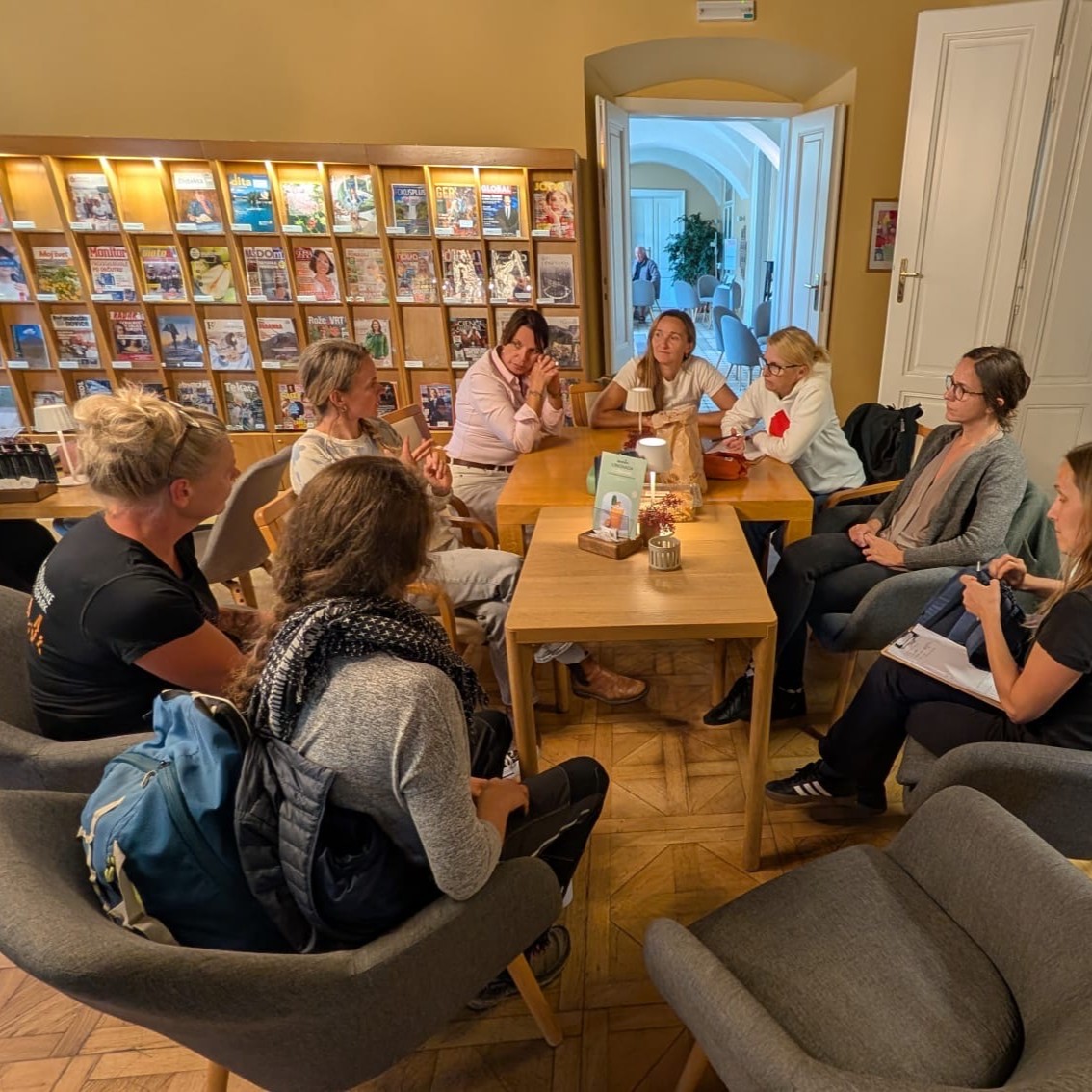
This was exactly the experience of the community lab in UNESCO Global Geopark Karawanken/Karavanke, run by Claudia Grünberg on behalf of IE. The lab involved Geopark staff, heritage professionals and representatives of local community institutions from both sides of the border. It was initially prepared around the topic of how Austrian and Slovenian cross-border communities relate to the heritage managed by the Geopark in which they live.
Lesson one: Sometimes the starting point gets in the way.
A rookie mistake, perhaps, but the topic proved to be an obstacle rather than a catalyst for exchange because it framed the conversation and the actions that might follow too tightly. It did not fully match what participants felt was most important to them.
So, instead of moving on, the group prolonged the empathising stage. Participants talked at length about what their local heritage meant to them, and a topic emerged naturally from the conversation: the gap between the heritage narratives promoted by the Geopark and the interests of local people.
The catalyst emerged from the participants themselves, through Claudia’s careful facilitation.
Once this hurdle was cleared, the group’s thoughts quickly flowed towards what the Geopark meant to each person. They reviewed existing interpretive services and discussed how these could be improved to connect more closely with the meanings and values held by local people, while involving them in the process.
Lesson two: Practice changes things.
Once the group had identified a topic they could relate to, participants began experimenting with facilitation and participation techniques. They took turns facilitating parts of the discussion, drew quieter voices into the conversation, and worked together to develop ideas for future interpretive activities. At the beginning of the process they felt not at all prepared even with the theory learned from the online training.
The leap from classroom to field can be too big if the objectives of a community lab are too prescriptive. Participants may then have little sense of ownership and no grounds to facilitate exchange. So, it was a challenge for IE and the Geopark, as organisers, to keep the process ‘loose’ yet help people reach ideas for action together so they could see something tangible emerging from their efforts.
There were, for example, ideas about how the Geopark could involve people in future awareness events, plans for a large community event, and suggestions for reviewing interpretation in a visitor centre so that it relates more closely to local people.
Lesson three: Failing to plan is planning to fail, but over-planning can fail too.
In our community lab experience, if the plan is too detailed and rigid, it may fail. However, the design thinking process did provide a necessary thread to focus comments, develop ideas and help participants identify the ingredients for interpretive experiences that could help the Geopark promote natural and cultural heritage in a way that local people can relate to.
In conclusion, the community lab proved to be a very intense but rewarding experience. The Geopark gained many insights from the community into its work and improvements it could make. It may also adopt the lab approach for a larger community event early next year.
At the start, participants were unsure about how to move from the theory of participation to facilitating it. In short, we, the organisers, tried to plan a participatory process, but our first plan got in the way. So, we changed it, allowing the participants more freedom to define the issue. That changed the dynamic and eventually led to concrete ideas for the Geopark.
Once the participants helped define the issue themselves, they began to take more ownership of the discussion and to experiment with the techniques they had covered online.
For all participants, Geopark staff, heritage professionals and representatives of local community institutions from both sides of the border, the lab provided an opportunity to experience the power of working with people outside their usual circles of interaction. Hopefully, this is the beginning of the change in mindset and way of working needed for genuinely co-creative meaning-making.
The EMPATHS project is co-funded by the European Union Erasmus+ programme.
More details: https://empaths-project.eu
Alexander (Sandy) Colvine is IE’s Project Manager for the HI-People network grant. He can be contacted at: alexander.colvine@interpret-europe.net.