Interpreting the familiar is a challenge, especially when it comes to soundscapes.
Do you think that living in the countryside is quiet? What would London be without the melodious sound of Big Ben? What would Mediterranean summers be without the chorus of cicadas?
In heritage interpretation, we often talk about multisensory experiences: smell, taste, touch – and, of course, sound. Sound can be particularly powerful. Music has always played an important role in intangible cultural heritage, and today technology gives us new ways to bring sounds, songs and stories into heritage experiences. Folklore songs, for example, can be reproduced during a tour, or incorporated into living heritage experiences, adding another layer to the visitor’s sensory journey.
But recently, I encountered a type of sound that made me think differently about what we consider heritage. The sounds we don’t notice. I often remember someone saying to me, “Wow, you can still hear hawks around your house!” For me, this was almost surprising. Not because I couldn’t hear them, but because I had never really thought about them.
In cities, we often talk about urban white noise. We become accustomed to it and eventually stop consciously noticing it. The same can happen in nature. Depending on where we live, the sounds of birds, bees, insects, sheep and goat bells, cats, rustling leaves and the wind can become part of our everyday acoustic environment. They are so familiar that we stop listening to them.
Yet these sounds can also be references to place. They tell us where we are, who inhabits this place. They can evoke memories, seasons, landscapes and ways of life. And, just like smells or tastes, they can carry cultural meaning.
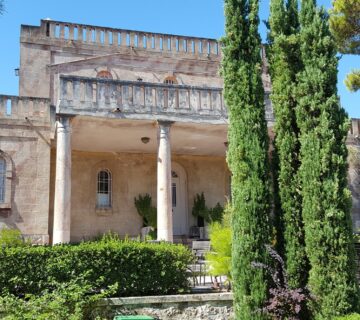
This question became particularly relevant to me during a recent project on Andros Island in Greece, where we developed two interpretive walks exploring the heritage of the lemon. As part of the project, a large library of soundscapes was created.
At first glance, these might seem like ordinary recordings. But perhaps that is exactly the point. How should heritage interpreters deal with sounds that are so familiar that we hardly notice them? How can we transform an everyday sound into an element of interpretation? And, more importantly, how can we use sound to make visitors listen differently?
Digital interpretation gives us some exciting possibilities. A sound does not necessarily have to be the main attraction. It can work subtly in the background, create an atmosphere, accompany a story, or become the story itself.
For example, in an audio tour or digital interpretive app, we could use familiar sounds in several ways:
- A sound carpet – A natural soundscape playing quietly underneath the interpretive guide’s narration, creating a stronger sense of place.
- A phenomenon to be interpreted – Instead of simply using a bird sound as background, why not invite visitors to stop and listen? And consider what its presence tells us about the landscape?
- An interactive sound game – Visitors could be challenged to identify sounds around them, match recordings with places, animals or elements of the landscape, or even distinguish between sounds that belong to different places or seasons.
These approaches turn listening from something passive into something active.
Learning to listen again: Perhaps the most interesting opportunity is not to introduce visitors to sounds they have never heard before. Perhaps it is to make them notice sounds they have heard all their life. And once we start listening, the landscape changes. We begin to realise that sound is not simply an accompaniment to a heritage experience. It can be a way of understanding place.
So perhaps the question for heritage interpreters is not simply: What can visitors see here? But also, What can visitors hear? And, What have they stopped noticing?
Because there is no silence in nature. We just need to learn how to listen.
Penelope Gkini works as an interpretive guide and mountain leader. She is an Interpret Europe certified interpretive trainer. You can contact her at: porizocrete@gmail.com.