Place, dialogue, encounter, and the continuation of ideas through heritage.
Have you ever visited a place that stayed with you long after you had left? Not simply because it was beautiful. Not simply because it was old or picturesque. But because you felt that something invisible was still there, perhaps a memory, an idea, a conversation that had never really ended.
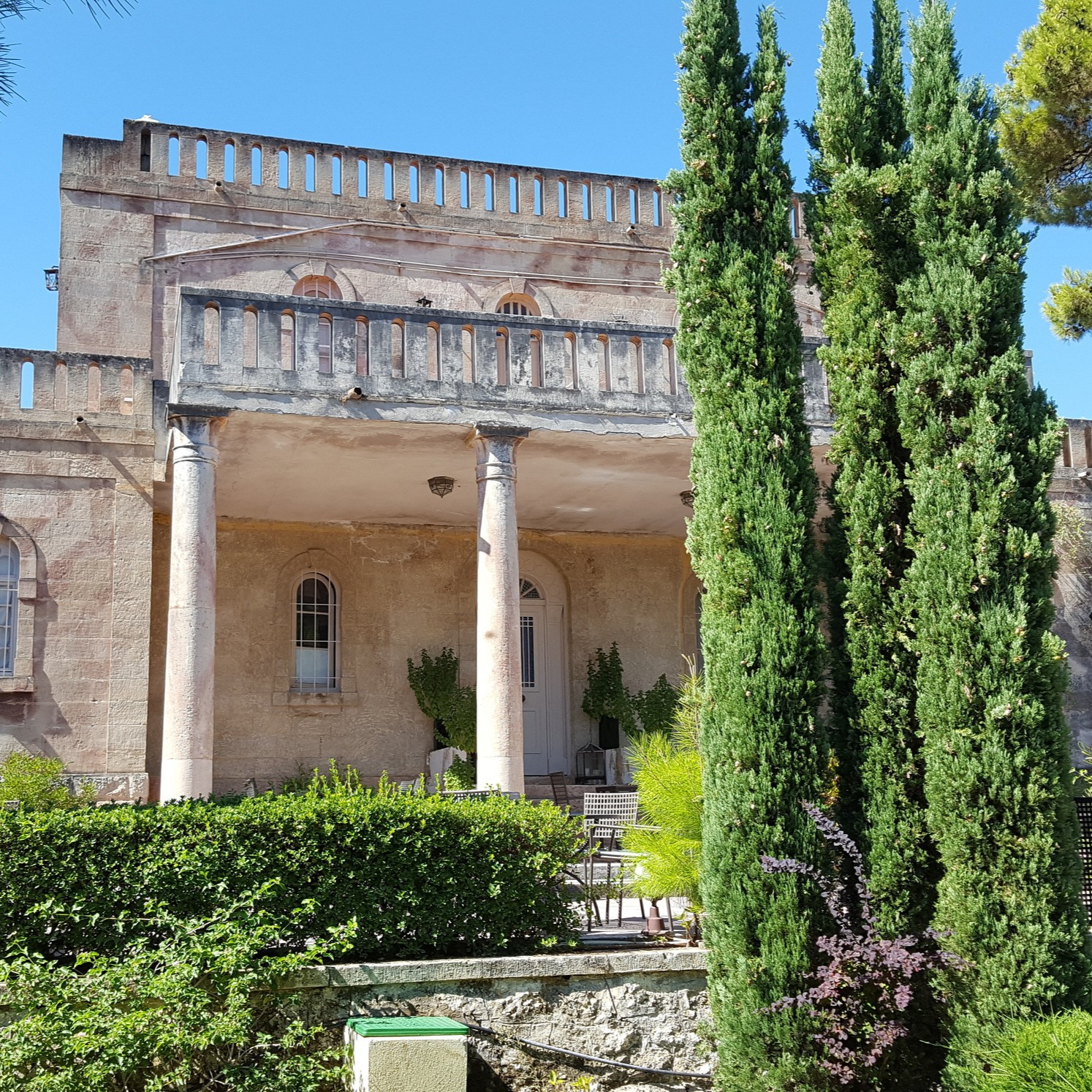
In Sykia, on the northern coast of the Peloponnese, Greece, there is a house that invites precisely this kind of encounter. Hidden among the pine trees of Pefkias forest, beside the Corinthian Gulf, stands the villa of the Greek poet Angelos Sikelianos and his wife, Eva Palmer. Completed in 1916, the villa is one of the distinctive literary and cultural landmarks of the area. Its architecture brings together references from different layers of the Greek past, including classical, Byzantine and Ionian/Venetian influences. Yet the building itself is not the most interesting story. The first thing an interpretive visitor encounters is not the villa. It is the landscape.
Pefkias is a coastal pine forest where the trees grow just beside the Corinthian Gulf, creating a striking meeting of land and sea, enclosure and openness. The villa stands within this landscape, and its setting is essential to understanding the atmosphere in which Sikelianos and Palmer lived and created.
This immediately raises a simple question: Why there?
Instead of beginning with dates and architectural details, the question invites us to look: the pine trees, the sea, the light, the sounds. So, the landscape becomes part of the story.
For Sikelianos, nature was not merely scenery. His relationship with the natural world was deeply connected with his artistic and philosophical outlook. The house, therefore, becomes more than a residence; it becomes part of a particular environment of thought and creativity.
Then we can look at the building itself. Its architectural language is equally layered. Classical references coexist with Byzantine elements and influences from the Ionian and Venetian traditions. Rather than belonging entirely to one historical period, the villa brings different cultural layers into conversation. In a sense, the house is already expressing an idea that was central to Sikelianos and Palmer: that the Greek past could be revisited, reimagined and brought into dialogue with the present.
Furthermore, the villa became a meeting place for people connected with the intellectual and artistic life of the period. Historical sources associate Sykia and the villa with famous poets, including Nikos Kazantzakis, Kostis Palamas and Kostas Karyotakis, among others.
It would be easy to turn these names into a list of famous visitors, but a list of names does not necessarily create an interpretive experience. So instead, imagine them as voices. A poet. A novelist. An artist. A composer.
Different personalities, different ideas, different visions of Greece, sharing a physical and intellectual space. What might they have discussed? What did they disagree about? What ideas were born from these encounters? And, perhaps the most important question, What would you have asked them if you had been there?
This question changes the visitor’s role. We are no longer simply looking at a historic house or receiving information about the people who lived there. We are imagining their voices and becoming participants in a conversation that began long ago.
This is what makes the villa particularly interesting as a place of heritage interpretation, a place where literature could meet music, ancient Greece could meet modern artistic experimentation, nature could become a source of inspiration, personal relationships could develop into cultural projects.
The relationship between Sikelianos and Eva Palmer is especially important in this respect. Palmer was not simply the poet’s wife. An American by birth and deeply engaged with Greek culture, music, theatre and traditional arts, she was an artist and cultural figure in her own right. The Delphic vision that emerged from the world of Sikelianos and Palmer eventually took form in the Delphic Festivals of 1927 and 1930.
Therefore, we do not simply interpret what survives. We interpret what connects the surviving place with questions that still matter.
Today, the villa exists in a very different context from the world of Sikelianos and Palmer. Its surroundings and use have changed, and the people who filled the house with conversation are long gone. Yet the place can still provoke questions.
Standing among the pines, looking towards the house and the sea, we can imagine the conversations that once took place here and, for a moment, create a new one. That is where interpretation can begin. Not with just an instruction to admire a historic building, but with an invitation to enter into a relationship with it. A heritage place does not necessarily have to give us every answer. Sometimes it gives us better questions.
How can the past become a source for creating something new? How can encounters among people shape cultural ideas? What happens when different perspectives meet in the same place? And finally, What conversations deserve to continue today?
Perhaps this is what makes the Villa of Angelos Sikelianos more than a historic residence. Its walls preserve a past. Its landscape preserves traces of a particular way of life. But its greatest potential may lie in the questions it can still inspire. Because heritage is not only what survives… It is what continues to speak!
There is also a more personal reason why this place continues to speak to me. I spent my childhood summers in Sykia, growing up with memories of Pefkias — its pine trees, the sea, the paths through the forest, and the quiet presence of this particular house. Long before I approached it as a heritage site, I knew it simply as part of the landscape of my childhood. Perhaps this is why, when I return to the villa today, I find myself thinking not only about the people who lived there a century ago, but also about the way places become part of our own stories. A landscape can hold memories that are deeply personal, while at the same time carrying memories that belong to a much wider cultural past. The two can meet in the same place. And perhaps this is where my own encounter with the villa begins.
Georgia Pyriovolis is an English teacher, certified tour leader and mountain guide, as well as a pioneer of Forest Bathing practice in Greece, recognising the profound link that nature plays in cultivating health and wellness. She facilitates nature-based experiences that foster reflection, dialogue and meaningful connection with place. She can be contacted at: gpyriov@gmail.com.