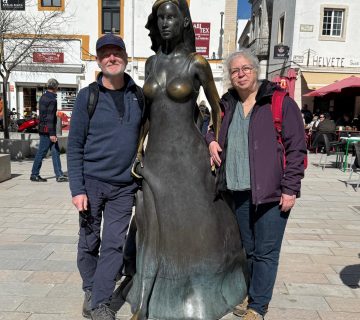
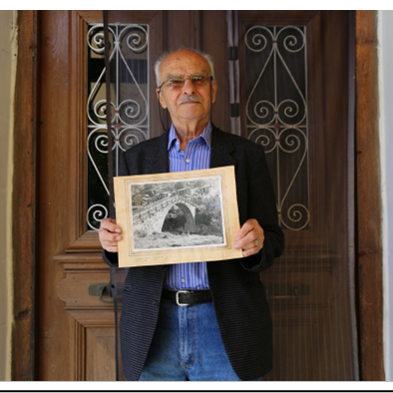
IE’s interpretive agents, Kalliopi Stara and Dimitris Ioannidis, share their experience from the co-creative workshop in Zagori, Greece.
IE’s Learning Landscape initiative, in collaboration with UNESCO, aims to arm interpretive agents in four different regions in Europe to strengthen local stakeholders’ capacities in heritage interpretation, and together create an interpretive strategy for their region. In January 2026, at one of these regions (Zagori, Greece) Kalliopi and Dimitris organised a co-creative workshop that brought together stakeholders to discuss heritage interpretation for the very first time. We asked them to share their experience, together with Dimitra Kotsia, one of the participants.
What do you consider to be the greatest success of the workshop?
Kalliopi: The greatest success was the level of participation and the quality of discussions. These were achieved because people trusted in us, thanks to our long-term presence in the area. We visited many villages, discussed with the residents, encouraged local actors to get involved. Logistics helped too: a well-organised venue, offering handmade local delicacies, being punctual and treating everyone equally, regardless of their professional attributes. The result was a friendly, comfortable atmosphere – the perfect basis for co-creation!
Dimitris: Οur venue, the old school at the village of Miliotades, proved to be an ideal choice in terms of ambience as well as accessibility. We had to carefully design the invitation and to compile a list of invitees. That part was very significant as we had to ensure that a wide range of stakeholders would be invited, and no one would feel left out. We sent about 70 personal invitations but dealing with the Greek reality of people not responding to invitations, we were unsure up to the last minute of how many people to expect. This is an issue when it comes to space required, adequate number of chairs and tables, catering provisions, etc. Finally, 37 people took part at the workshop, and we think that this was a very satisfactory turnout for the co-creative workshop.
What advice would you give to those wishing to run a co-creative workshop?
Kalliopi: Τhe organiser needs to put themselves in the participants’ shoes. In our case, choosing the location was also important, since it helped everyone, both locals and visitors, understand the ‘genius loci’. Starting from there, we explored their hopes, concerns for Zagori, their expectations from UNESCO’s designation, etc.
During the workshop, we used familiar visual stimuli that highlight values such as beauty, honour, respect for heritage, and nature conservation. These specific objects and concepts made it easier to then discuss more complex topics, such as authenticity.
Dimitris: Not knowing in advance the number of people that would finally participate in the workshop was a difficult uncertainty to deal with. Ultimately, we had to prepare for the best and expect the worst scenario in dealing with either an overcrowded room or a small group of participants. We also had to ensure that all participants would feel at ease and free to speak their minds. From the outset we said: “Here we are all equal, whether we come from the Ministry, the Municipality, the academia, the local villages or the farms”.
Dimitra, as a participant, how did you experience this workshop? Was it worth it, in your opinion?
Dimitra: I found this workshop to be an important event, something between education and research. Even if we all live in the Zagori area, the workshop gave us the opportunity to get acquainted with our own cultural heritage, as well as with each other! This sets the basis for a future fruitful collaboration between us, the residents, and the local authorities and even Interpret Europe and UNESCO.
So, in the end, the workshop didn’t just ‘train’ us all but also reinforced our local identity. Through interpreting our own heritage, it encouraged a sustainable relationship between us, the locals, our heritage and the visitors.
How would you like to see the outcome of this workshop implemented in Zagori?
Dimitra: A practical outcome of the workshop could be different interpretive services, like interpretive walks, panels, leaflets and even apps for the villages of Eastern Zagori. Then participants can get to know our villages, their traditional character but mostly our local history.
Also, I hope that the workshop will lead to initiatives that will encourage us, the locals, and especially the young ones, to find ways for protecting and interpreting our heritage. Then, all the knowledge that has been accumulated will expand beyond theory, and become a medium for development and for preservation of our local identity.
Kalliopi: Indeed, continuing these activities and keeping this network alive is our challenge, as we continue to work together.
Valya Stergioti was IE’s first Training Coordinator and held the position for eight years after establishing the training programme. She is a member of IE’s Learning Landscape initiative team and runs her own interpretive consultancy in Greece: Ali Meria. Valya can be contacted at: vster@outlook.com.
Dimitris Ioannidis is an architect and heritage manager. Although based in Athens, he spends six months a year in Zagori where he is working towards turning his ancestral home into a museum of local history and culture. He can be contacted at: zagoristas@gmail.com.
Dimitra Kotsia is an Agronomist – Agricultural Advisor. In her free time, she actively participates in cultural activities in the village of Liapi Zagoriou (insta# Liapi_Zagoriou) and does volunteer work. She can be contacted at: demikotsia@gmail.com.
Kalliopi Stara (MSc Ecology, PhD Folklore) is a researcher and lecturer on Cultural Ecology. Her research interests focus on Sacred Natural Sites, Ethnobiology and ICH. Her book ‘The Trees of Our Land’ (Arteon 2021) was awarded by the Academy of Athens in 2022. You can find out more and contact Kalliopi here: https://kalliopistara.com/
To cite this article:
Stergioti, Valya (2026) “Here we are equal, regardless of where we’re coming from”, Interpret Europe Newsletter Spring 2026, p. 7–8.
Available online: Interpret Europe Newsletter Spring 2026.