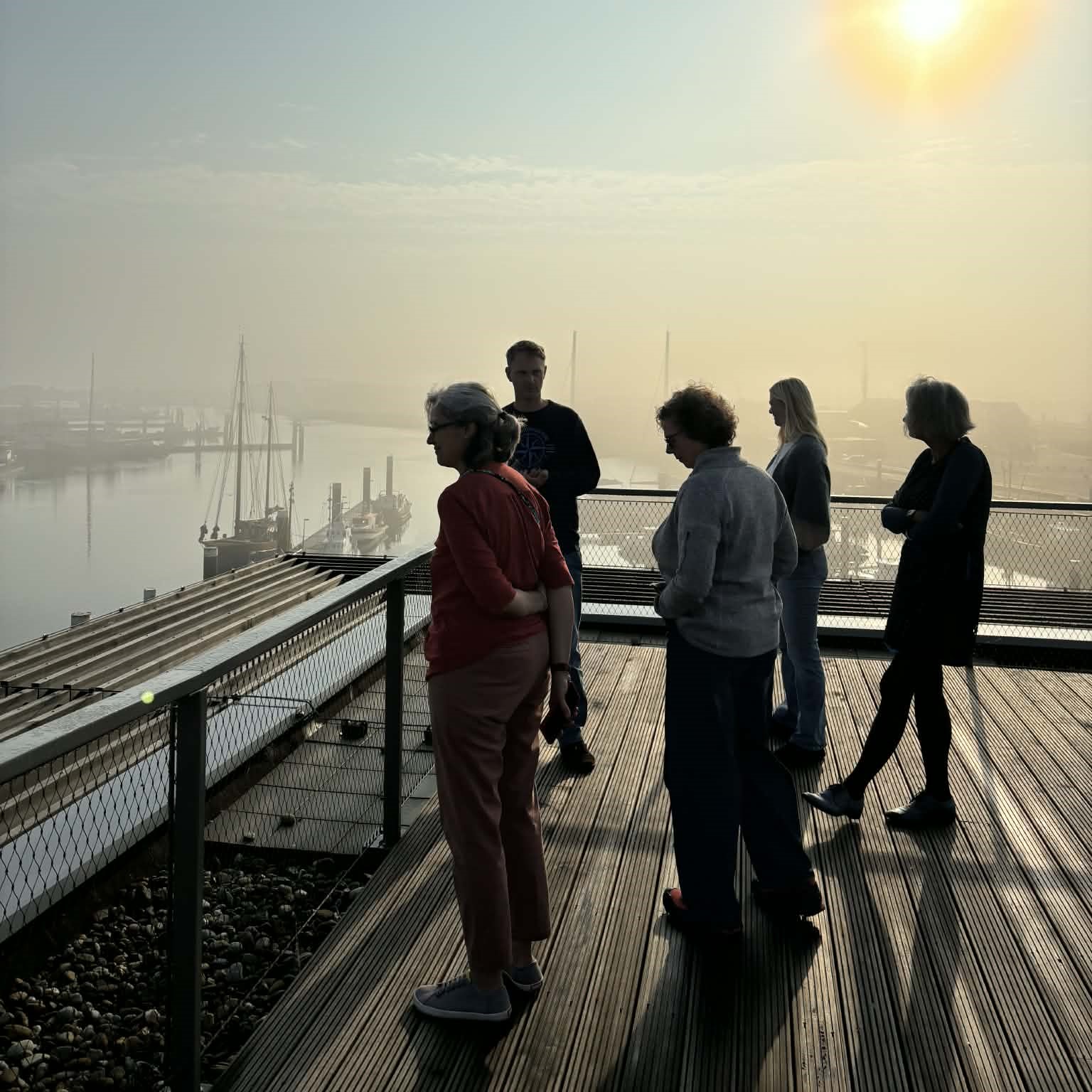
The IE Certified Interpretive Writer (CIW) course offers an opportunity to step out of one’s own sphere and find meaning through collaboration.
Writing is usually a solitary activity. However, during the Interpret Europe CIW course we found a unique opportunity to step out of our own perspective (and from behind a desk) and distil meaning through dialogue, conversation, and collaboration. In our small group – just five participants – we were able to engage in deeper reflection, exchange ideas, and jointly explore universal values that lie at the heart of heritage interpretation.
The Wadden Sea: A place of paradox
The training took place in a location full of paradoxes. The phenomena we were asked to describe were new to us, and the cultural context we found ourselves in was unfamiliar. The Waddenzee is natural heritage, yet created through human activity. Strongly connected to the historically harsh and brutal living conditions of local communities, who have always faced the forces of nature, the site allowed us to experience how human history and nature together shape the landscape we now have the chance to interpret.
The role of the trainer and collaborative practice
Our trainer combined methodological rigor with creativity and sensitivity to cultural meaning. Under her guidance, we worked daily in the field and in the classroom, both individually and in groups, practicing interpretation as a tool to transform visitor experiences into personally meaningful encounters.
The workshops demonstrated that interpretation is about more than the object or site itself; it is about the story we craft and the values we convey – such as respect, shared responsibility, and sustainability. Working together allowed us to filter ideas through shared values and test them in practice.
From text to values
Assignments included various forms of interpretive writing. Each participant prepared an individual interpretive panel, reviewed not only by the trainer but also by the other participants. This allowed us to check whether the message was clear across different cultural backgrounds, highlighting that concepts like ‘natural landscape’ or ‘social responsibility’ can vary greatly depending on context, and that heritage interpretation requires this sensitivity. This is a key skill that will be useful in our museum, where visitors come from many different places around the world.
What we take home
Participating in the CIW course is not only about developing interpretive writing skills but also about learning a new way of thinking about heritage. Only by standing next to the object, in its space, can one truly check whether the text fits the place and enhances the visitor’s experience.
Working in Lauwersoog, a place where the sea has turned into a lake and a national park is a human-shaped landscape, offered a hands-on experience of this principle. Surprisingly, the setting of the course also gave us a chance to understand how Dutch settlement patterns influenced regions in our home country, Poland.
Even though the schedule was tight, we still managed to see a bit of the Netherlands and – thanks to our colleagues at WEC, the World Heritage Centre Wadden Sea – try mustard soup.
Our participation in the training was funded by the European Union as part of the project It’s time for Maria! Developing adult education staff at the Maria Skłodowska-Curie Museum in Warsaw.
Aleksandra Głowacz is an art historian. She is responsible for audience development at the Maria Skłodowska-Curie Museum in Warsaw, Poland. Aleksandra can be contacted at: a.glowacz@mmsc.waw.pl.
Marta Hekselman is a member of the Audience Development Department at the Maria Skłodowska-Curie Museum in Warsaw, Poland. Marta can be contacted at: m.hekselman@mmsc.waw.pl.
To cite this article: Głowacz, Aleksandra & Hekselman, Marta (2025) ‘Distilling meaning together at the Wadden Sea’ in Interpret Europe Newsletter 4‑2025, p. 11-12.
Available online: Newsletter winter 2025