A Certified Interpretive Guide (CIG) course in Lubmin raised big questions.
I wasn’t a model participant. The Certified Interpretive Guide (CIG) training recently hosted by the Tourism Association of German Western Pomerania was split across two weekends in October and November. A six-week hiatus gave participants ample time to come up with a short interpretation for their practical exam. It also helped me forget that all interpretations were to take place within a particular two-hundred-metre section of the seaside, all beach, dunes, and forest. So, when I finally thought about what interested me as an interpretable phenomenon in the seafront village of Lubmin, just 20 kilometres from where I live, I picked the pizzeria.
As a result, I had to spend the evening before the last day’s exam developing a new 10-minute interpretation, this time on a phenomenon within the designated area.
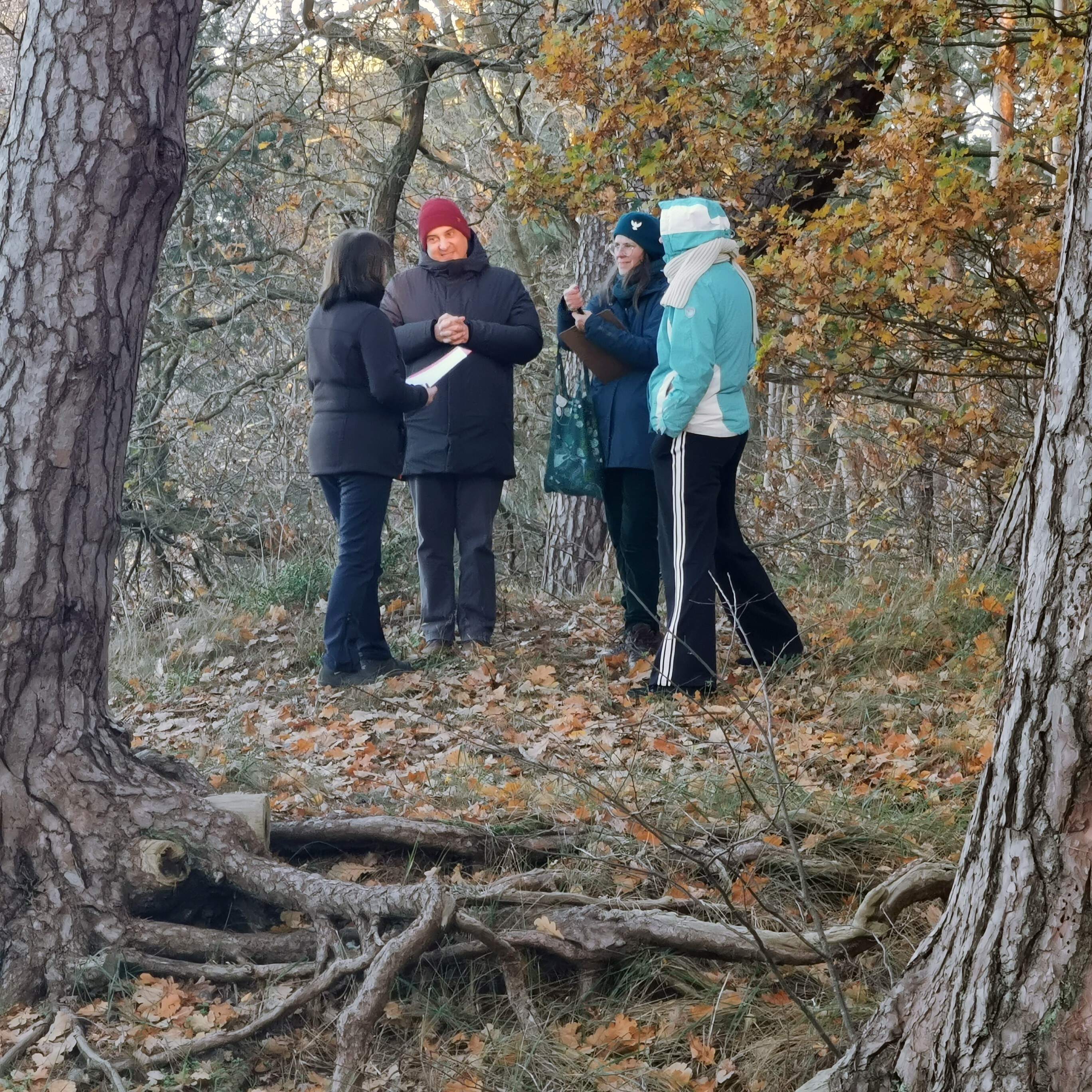
I had already gone off track that afternoon when we practised turning controversy into dialogue. Each one of us was to give an off-the-cuff interpretation of an item collected in the forest while successfully moderating controversial reactions from the group. But there never were any. So, when my turn came, I interpreted a dead flower that still held up its seeds as nature’s lesson on how we should be ready to sacrifice ourselves for the future of our nation, and so on. The group went along complacently. It took near-verbatim national socialist stock phrases finally to raise some eyebrows. However, not only did my demagogue act fail to provoke open controversy, it also kept me from following up on the groups’ responses and developing a real dialogue.
As weird as my experiment was, it flew from a genuine concern about the interpretation of natural heritage. If interpretive themes frequently draw analogies between natural phenomena and human life, are interpreters reinforcing the dangerous idea that what is natural is ‘right’ and vice versa?
So, there is some irony in the fact that the short interpretation I prepared over the following night, the way it actually turned out, fell into the same basic pattern as my social Darwinist act. The main difference was that it worked from cosmopolitan values.
Having realised that I couldn’t use the pizzeria for my practical exam the next day, I needed to pick a phenomenon located within the designated area. As we walked back through the wet dusk to the holiday facility that was our base, I noticed a birch tree that grew like a contorted shrub beneath the tall pines of the coastal forest. Well, why not? After dinner, I read up on birches.
The next day, as we criss-crossed the area from one participant’s spot to the next, it became clear that most of us had chosen trees to interpret. So, when my turn came and we arrived near the birch, I welcomed the group to another stop on the ‘Trees and People’ trail.
As taught by our trainer, my interpretation proceeded along three facts and their meanings. Firstly, I got the group talking about the tree species of the forest around them, which they duly labelled either as native or as invasive and dangerous. Secondly, we approached the birch, described it, and discussed what its posture felt like – a little uncomfortable, that is. The revelation came when I asked the group to check the tree against some identifying traits of the weeping birch (Betula pendula). Conveniently, a colleague had already used one for her interpretation without even bothering to name the species, overwhelmingly common as it is in Germany. But this tree was different. I suggested that it could be a downy birch (B. pubescens) or a hybrid of the two species. The downy birch is known to occur here and there in Western Pomerania and across much of Europe, but is much more at home in Scandinavia.
Thirdly, I told the group how, 28 years ago, a young war refugee from Kosovo arrived in this northerly post-communist land of fish sandwiches and fried potatoes. He was a trained cook, and a friend who ran a restaurant in a nearby town took him in. During a visit to the seaside, they were approached by a local: Weren’t they the guys from that pizza place? This parish needed one, too! The refugee decided to put down roots in foreign soil and made Lubmin a better place to eat. Today, Mr Aliçkaj runs Pizzeria Adria together with his brothers, their wives, and their children, who were born here.
We were long past the 8-minute signal, and I quickly wrapped up my interpretation with the theme sentence: Both among trees and people, immigrants can enrich communities.
My rookie planning meant that we didn’t get to discuss our own experiences of feeling out of place and becoming at home, or to question the connotations of ‘native’ and ‘invasive’ species as ‘good’ or ‘bad’. And I would have preferred to end my interpretation with a coda on the diversity of scenarios encompassed by that little word, ‘can’. This training brought us a long way in the craft of interpretive guiding, yet creating conversations that embrace complexity and uncertainty across nature and culture may remain a challenge even for seasoned professionals, or so I guess.
Philipp P. Thapa is an ecologist, philosopher, and writer based in Germany. You can contact him at philipp.thapa@elfenbeynturm.de.
To cite this article: Thapa, Philipp P. (2025) ‘Interpreting across nature and culture’ in Interpret Europe Newsletter 4‑2025, p. 13-14.
Available online: Newsletter winter 2025