Creating personal experiences for visitors in relation to heritage, we forge connections that transcend the mere presentation of facts.
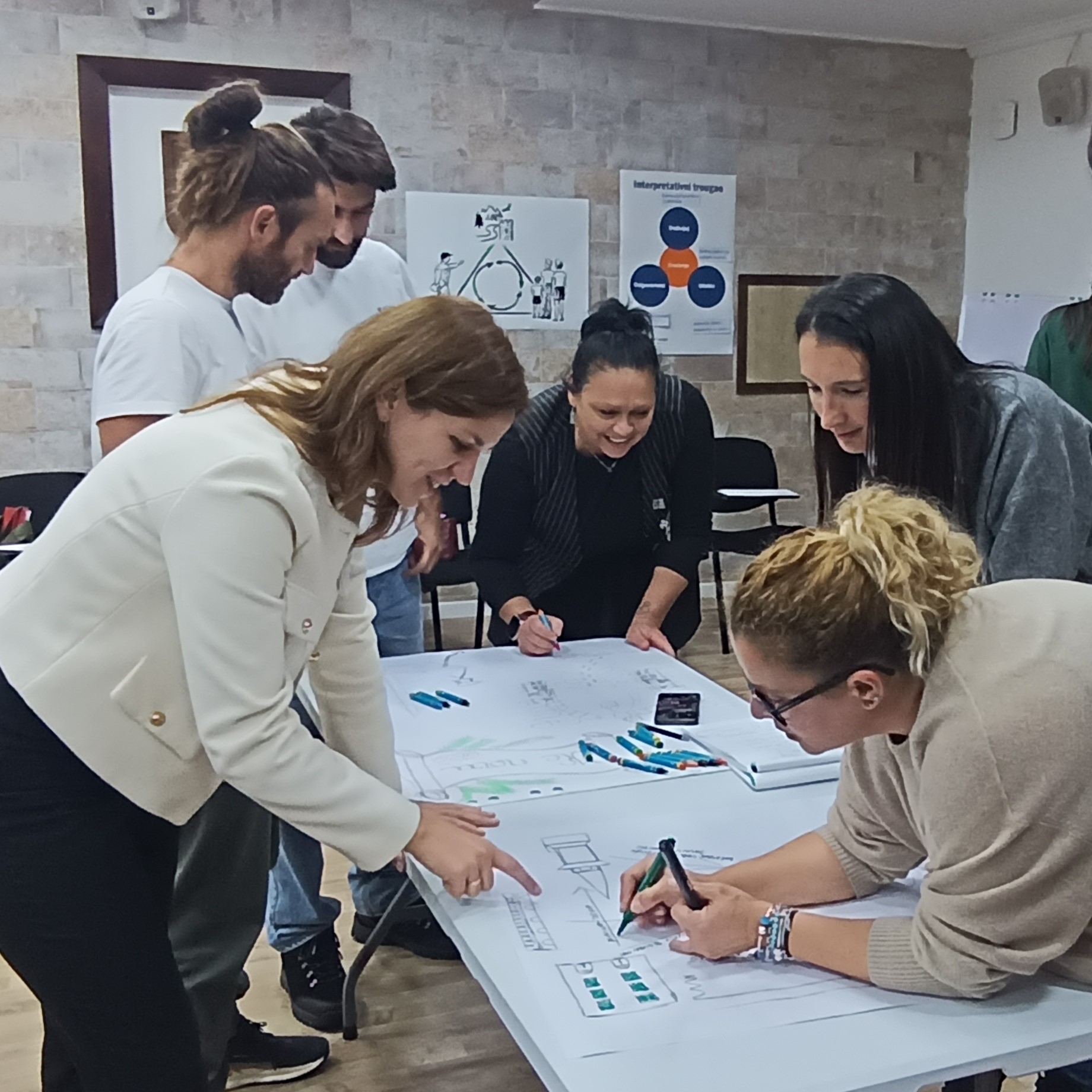
In collaboration with the Municipality of Kotor and the Public Institution ‘Museums’ Kotor (OJU ‘Muzeji’ Kotor), a heritage interpretation course was held in early December this year at the Multimedia Hall of the Cultural Centre (Centar za kulturu) in Kotor, Montenegro. It was actually an Interpret Europe Certified Interpretive Guide (CIG) course, this time delivered with the support of UNESCO under Interpret Europe’s Learning Landscapes initiative (LLI). Valya Stergioti, from IE’s LLI team explains: The main outcome for each region of the Learning Landscapes initiative is its own co-created interpretive strategy, and IE courses are an indispensable part of the procedure. Not just as the means to build the participants’ capacities on interpretive planning, writing and guiding, but also because through them, stakeholders develop interpretive plans, guided walks and non-personal interpretive media for their own sites, that form the flesh and bones of their interpretive strategy.
Our training was designed as a combination of presentations, exercises, individual and group work, including exchange of opinions and conclusions among participants and the trainers. The goal was to improve methods of heritage interpretation according to IE’s contemporary principles. The majority of participants were experienced local guides who had the chance to familiarise themselves with the heritage interpretation guidelines, aiming for a more complete understanding of the importance of heritage and its preservation for future generations.
As a programme participant and a guide with decades of experience, and at the invitation of PI ‘Muzeji’ Kotor (I am a member of the institution’s Council), I accepted the opportunity to participate with a little skepticism. Given my knowledge and long-standing experience as a Montenegrin guide who daily presents and brings my country’s heritage to visitors, I wasn’t sure how much the training could really improve my interpretation techniques. Even during the introductory talks and practical exercises, it became clear to me that I have already been using these exact techniques in my own work. What was missing was knowing how to name them and an understanding of which one is the most appropriate for a given moment.
During the course, I re-lived memories of my guests with whom I am still in contact today—guests who remained connected to Montenegro because of those very moments when I found the storyteller within myself. Some of them return often, others recommend the country to their families and friends, and I am responsible for every special feeling my country awakens in them. It is not possible to achieve such a connection with a guest every time, but when it happens, you know you have conveyed a part of the love you have for your calling and your country.
Through practical exercises with my colleagues—some of whom I have known for many years—I realised that even professionals such as themselves were taken aback by the emotion created by precisely executed interpretation. The ability to use all the learned techniques to create a completely new experience of familiar phenomena for them surprised me. Heritage interpretation has become a mission, not merely a task.
Living in Kotor and being someone who, every day, depicts its beauty and rich heritage to thousands of people, is a privilege. As a guide-interpreter, I have the unique opportunity to make this town inevitably important for them to understand the significance of heritage, and to build the need for them to treat that heritage, anywhere in the world, with respect and a profound personal feeling that touches both their hearts and minds.
Nataša Velimirović studied journalism at the Faculty of Political Sciences in Belgrade. She has worked as a freelance tourist guide in Montenegro since 2008. She is a member of the Council of the Public Institution ‘Museums’ Kotor. Nataša can be contacted at: velimirovicnatasha@gmail.com.
To cite this article: Velimirović, Nataša (2025) ‘When the interpreter meets the guide’ in Interpret Europe Newsletter 4‑2025, pp. 16–17.
Available online: Newsletter winter 2025