Busy as bees enjoying the spring, and there’s plenty of action to catch up on.
The HI-People project
HI-People, supported by the European Union Creative Europe programme, has begun its second year (of four) with some exciting developments for IE members.
First, our new mentoring and peer support programme is now up and running. Designed to help early-career and more experienced freelance interpreters/trainers meet the challenge of sustaining and growing their businesses, it complements our training programme to provide excellence in the practice of heritage interpretation and support to capitalise on these skills to forge a successful freelance career.
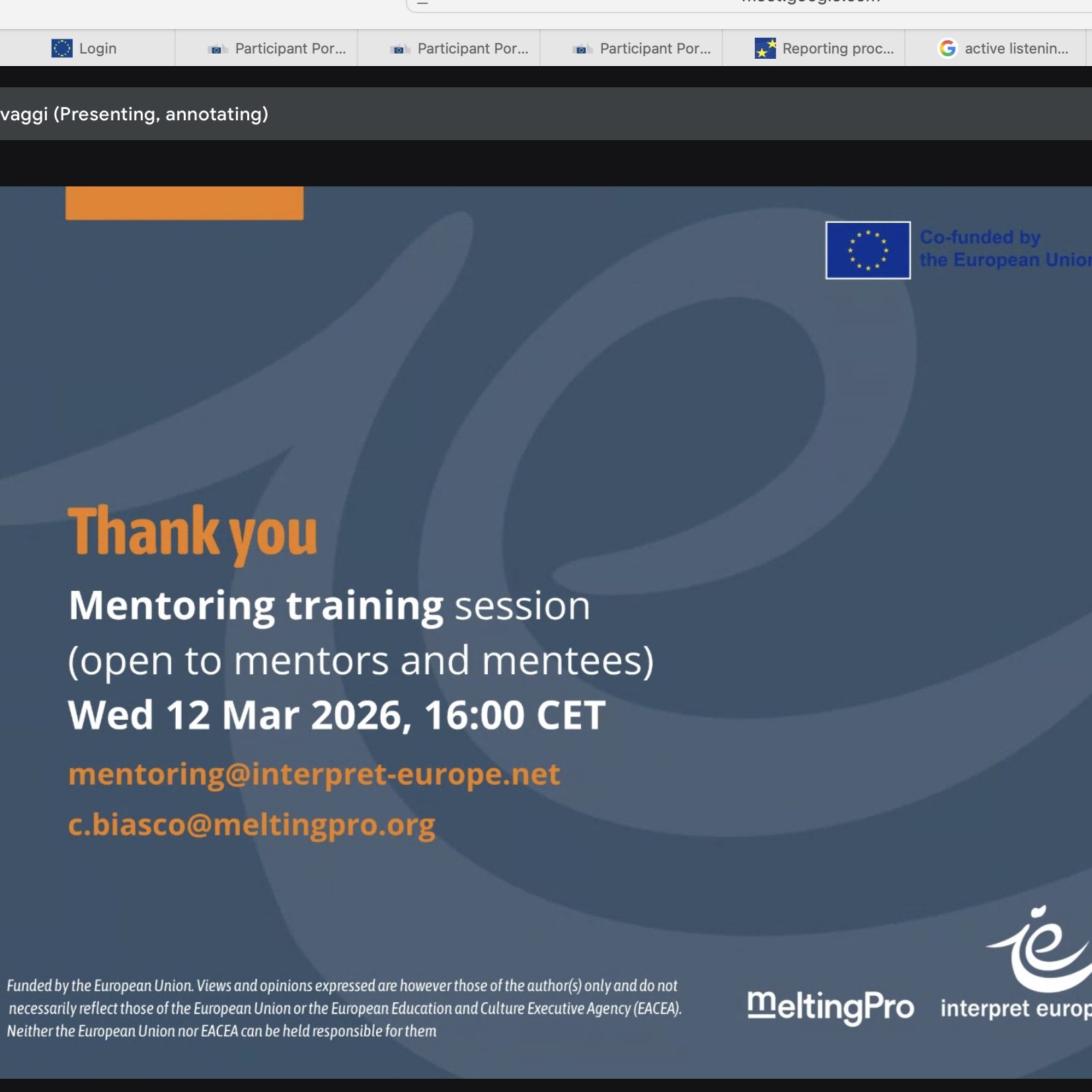
Our partner, Melting Pro, held an introductory meeting on 18 February attended by almost 40 IE members and non-members, with an inspiring keynote from UK interpretive consultant, Steve Slack. The meeting highlighted the importance of self-awareness, particularly personal and professional values, when establishing an online and offline presence in the marketplace.
Running your own business is always a challenge, but the mentoring programme recognises the value of the human connection as a supportive pact in which knowledge and values can be shared in a structured and empathetic relationship to build a robust freelance mindset.
The programme may have started life as a bullet point activity in a project proposal, but it is a key piece of the jigsaw, to equip a community of highly competent interpretive consultants and/or trainers with the mindset and resilience to succeed as freelancers.
We look forward to our first intake of mentors and mentees who will meet at regular intervals in 2026 to address the challenges mentioned above and this year’s topic of developing a digital presence, which came top in a recent survey of needs. Each year the programme will adopt a new topic based on a survey. If you missed the opening meeting but would still like to join the programme, it’s not too late! Just email mentoring@interpret-europe.net. Full details on the programme can be found here.
Another interesting addition is the IE training scholarship scheme, which offers up to 50% off IE training course fees, or for travel and subsistence if a course is provided free of charge, up to a maximum value of €300.
While we strive to keep our IE-certified training opportunities as affordable as possible, taking part in a five-day course, often in another country, represents a significant investment, especially for new interpreters just starting out. So, whether you are a new heritage professional or plan to make your career in heritage, we hope this new scheme can provide you with a welcome boost to justify your decision to become a heritage interpreter. Further details on eligibility, conditions and the application process can be found here.
Digital technology and AI are a growing part of visitor experiences at heritage sites worldwide, so the HI-People project offers us the opportunity to develop a training module for digital interpretation, which will take shape over the next two years. Targeting heritage professionals, curators and decision-makers, the module seeks to foster critical and considerate adoption of digital resources (including AI) to provide meaningful heritage experiences reflecting heritage interpretation principles and standards advocated by IE. In this way, participants can make informed decisions, brief providers, follow the planning process and engage in discussions with them to ensure that the resulting digital interpretation fulfils the aforementioned principles. The module will be accompanied by examples of best practice, ethical guidelines and a short series of webinars for members to discuss the subject. We hope to engage a multidisciplinary team who will work with the IE training team, as well as members with digital experience, to ensure that the activities best meet our short-term and long-term needs. More news to follow soon!
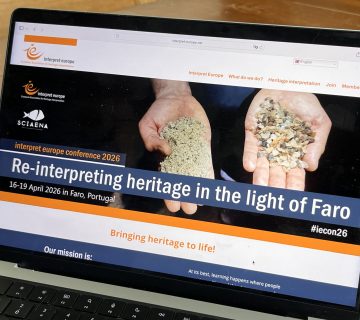
Finally, the IE conference 2026 in Faro, Portugal, marks the 21st anniversary of the Faro Convention and the notion of ‘heritage communities’ as well as people’s participation in heritage governance as a means of upholding democracy, human rights and sustainable development. It provides the stage for IE to advocate for a framework of reference for value-based heritage and people-centred approach to interpretation to affirm IE’s essential role in helping achieve these aims and to move closer to the centre of strategic decision-making and policy-making conversations. The conference is the starting point for the framework of reference and a subsequent forum for research and exchange on the subject over the next three years. In addition, there will be an interactive plenary workshop at the conference, to gather feedback, views and ideas to shape the future framework of reference.
The Empaths project
Empaths, our second European project, funded by the European Union Erasmus+ programme, is developing a pilot training course on participatory heritage interpretation for heritage professionals. It gives IE the chance to experiment with value-based interpretation with piloting partners at sites in Northwestern Greece, Southern Italy and on the Austrian/Slovenian border together with the people who live there. The ‘people’ part is key to the whole project as members of the local community will take part in the field-based part of the training, entitled ‘community labs’, to develop ideas for interpretive opportunities to enhance a specific site or a wider area of tangible or intangible heritage, such as an old stone quarry or traditional religious processions. It is, however, the process that matters, not the result. The piloting partners will soon invite local people to preparatory meetings to present the Empaths project, and to select the tangible or intangible heritage for the community lab. The community will have the final decision.
The heritage professionals will first follow a series of online training modules in May/June to learn the principles of participatory HI, before putting their knowledge into practice by facilitating a community lab in their pilot territory in September. Each lab will partially follow a ‘design thinking’ sequence with the aim of creating interpretive themes and narratives, or a format to tell a story from different perspectives. The way the community empathises with the heritage and with each other will dictate what ultimately transpires, so flexibility must be built in to avoid rushing stages or the influence of external agendas that might undermine the priorities of the local participants.
An experienced trainer in participatory practices involving HI will support the heritage professionals to facilitate the local community participants towards their goal, to validate their work and to consider how they might want to continue their efforts for a finished interpretive experience.
It will be an exciting and ambitious undertaking for the project, but the considerable experience of the local piloting partners who work extensively with local communities will be crucial to bring credibility, encourage people to take part and start a collective action that may continue beyond the lifetime of the Empaths project.
Click here for more details on the Empaths project and the latest news, including the Empaths newsletter and Empaths Manifesto.
Alexander (Sandy) Colvine is IE’s Project Manager for both EU-funded projects. He can be contacted at: alexander.colvine@interpret-europe.net.
To cite this article:
Colvine, Alexander (Sandy) (2026) “European projects update”, Interpret Europe Newsletter Spring 2026, p. 11–13.
Available online: Interpret Europe Newsletter Spring 2026.