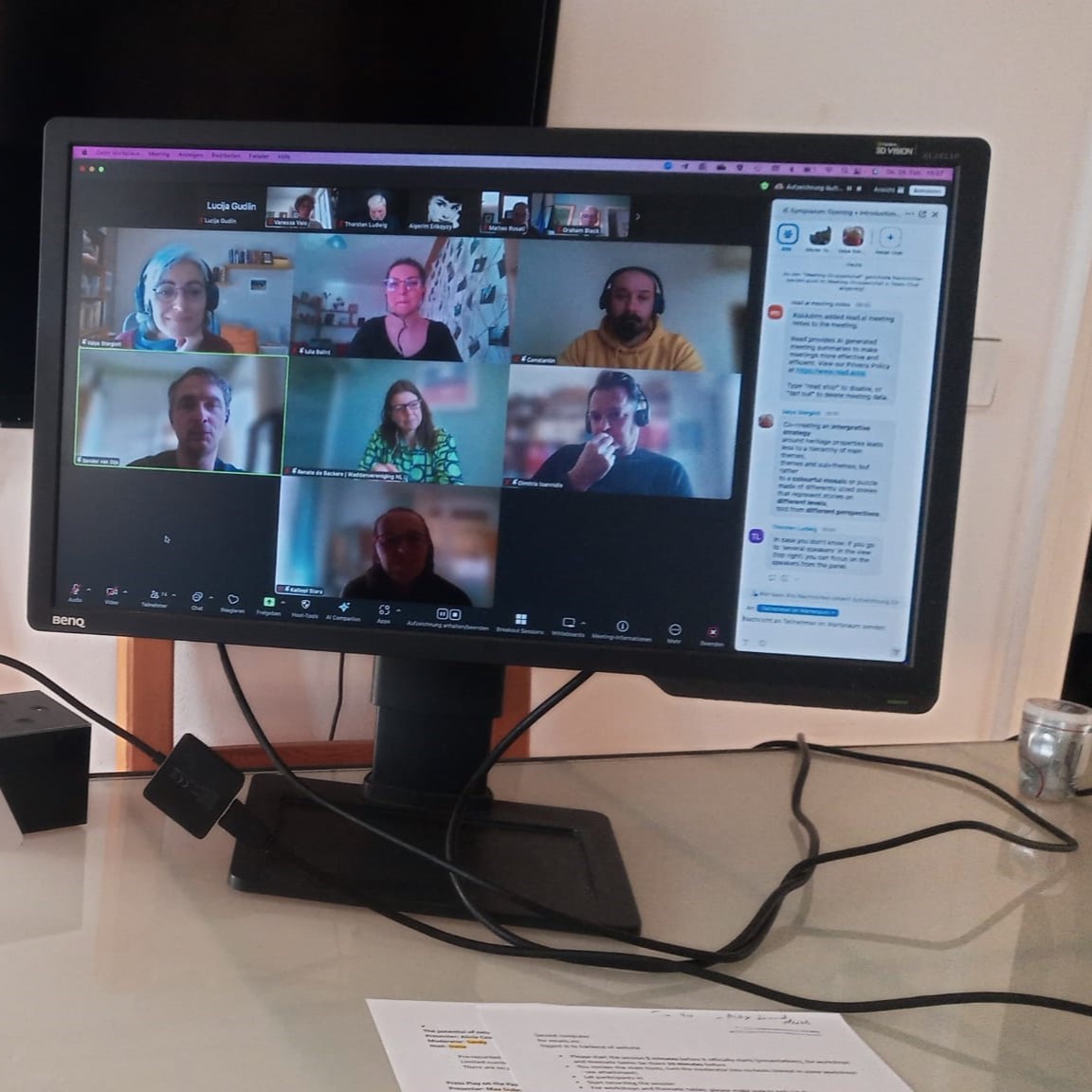
We met online. 27 presentations. 130 participants. The slides are gone — what stayed is harder to package, and far more useful.
On February 26 and 27, we held our first online symposium to allow a greater depth of exploration and discussion on one topic: The role of narratives in 21st century heritage interpretation. Delivered as part of the Learning Landscape initiative, which was established in collaboration with UNESCO, the online symposium invited heritage professionals, practitioners, researchers and educators to reflect on the role of narratives in contemporary interpretation. Moving beyond single stories and fixed messages, it provided a space to explore narratives as spaces for dialogue, learning and shared meaning-making.
What the symposium left behind (and why it matters)
When a symposium ends, what actually remains? Not the presentations. Not the programme. What stays is the conversation — the kind that shifts something, even slightly, in the way you think about your work.
The Interpret Europe online symposium was conceived as a new format: a space to explore one subject in greater depth than our usual conference structure allows – not instead of it, but alongside it. Across 27 presentations and with 130 participants from across Europe, this online gathering did exactly that. We asked some of those who took part — as presenters, agents, and experts — not to report back on what was said, but to reflect on what it stirred.
The value was in the friction
The most meaningful moments, Iulia Balint observed, happened when interpretation came closest to practice — when abstract concepts met the messiness of real sites and real people. Seeing ideas “in the making”, as she put it, is what makes them stick.
Bojana Čibej pointed to something equally important: the online format, often dismissed as second-best, created an unexpectedly horizontal space. Chat threads allowed challenge and commentary in real time, producing what she described as a “colourful mosaic of ideas”. But she also raised a sharper question — does attachment to a single methodology risk producing interpreters who are “narrowly mentally modeled”? Heritage is too plural for one-size-fits-all frameworks. The more principles we share, the richer our collective toolkit becomes.
Stories are never neutral
We live in a world where information is abundant but often fragmented — and where many different actors tell stories about places and heritage across a growing range of platforms. In this context, as Sabina Viezzoli argues, narratives in interpretation matter more than ever. Not because they provide answers, but because they offer something information alone cannot: a meaningful pause — space for attention, connection, and reflection.
Yet, working with narratives responsibly means acknowledging what they do and don’t include. Stories are never neutral. They amplify certain voices and quietly sideline others. As interpreters, our responsibility is to recognise those dynamics and actively make space for the perspectives that tend to get left out — rather than smoothing complex histories into a single, reassuring storyline.
Listening is not passive
Steve Slack reminded us that interpretation is not a broadcast. Multiple narratives make our work stronger — but only if we’ve actually heard them first. If we can’t listen fully and authentically to the stories that matter to communities, we can’t responsibly shape the narratives we tell. Listening is a craft, and it deserves as much attention as storytelling.
Towards discomfort — on purpose
Jon Kohl offered perhaps the most provocative reframe: if narratives are the primary way humans make meaning of the world, then interpreters can no longer afford to be just storytellers. They need to become mediators, facilitators, negotiators — roles rarely included in interpretive training, but increasingly essential. Heritage institutions have long preferred smoothed-over consensus. But in a fragmented public space where different perspectives and values compete, an “aversion to conflict” is no longer a neutral stance. It’s a missed opportunity.
What comes next
Iulia advocates for more “show and tell” formats — spaces to observe how others translate the meanings of their sites into practice. Sabina points to something similar: shorter, more regular opportunities for exchange throughout the year — thematic online sessions, a podcast series, or simply the chance to visit colleagues at the sites where they work. For her, the symposium also reinforced something more personal: a sense of belonging to a community that shares values, questions, and a genuine commitment to the practice.
Within Interpret Europe, the work now is to keep this space open — co-creative, inclusive, and willing to sit with the questions a little longer rather than rushing toward answers.
The proceedings from the symposium will be published soon, so keep an eye on IE’s website: https://interpret-europe.net/material/. Some participants were also inspired to write articles based on their thoughts and experiences, a couple of which you can read in this newsletter, and we hope there will be more to come as we foster this open space for exchange within our network.
Vanessa Vaio is IE’s Country Coordinator Italy and she is a member of the Learning Landscape initiative team. She can be contacted at: vanessa.vaio@interpret-europe.net.
To cite this article:
Vaio, Vanessa (2026) “What the symposium left behind (and why it matters)”, Interpret Europe Newsletter Spring 2026, p. 9–10.
Available online: Interpret Europe Newsletter Spring 2026.

)